


Genetic Nondiscrimination Bill Stalled in U.S Senate
Posted On Monday, November 19, 2007 at at Monday, November 19, 2007 by UnknownWith several private companies launching businesses to provide customers with unprecedented access to their genomes' secrets, legislation protecting people from genetic discrimination is more timely than ever. But Sen. Tom Coburn (R-Oklahama) is single-handedly stalling federal legislation to do just that.
The Senate passed earlier versions of the bill twice before, but they were blocked from coming up for House floor votes. This year, the House passed it by a bipartisan landslide, but Coburn has held up the legislation in the Senate, saying it could place too much strain on businesses.
"We're not really clear on what Coburn wants, because his excuses don't make sense," said the bill's original sponsor, Rep. Louise Slaughter (D-New York). "But if this bill got to a floor vote in the Senate, I think it'd pass almost unanimously."

23andMe, Navigenics and Decode Genetics have recently launched programs to scan individual's genomes and provide access to the information online. Customers will have to spend a for 23andMe's service.
In the absence of federal legislation, most states provide some degree of protection against discrimination. Many have gone further, explicitly providing genetic-privacy protections. Alaskan law (.pdf), for example, says DNA samples are an individual's private property. Still, companies offering personal genome scans, as well as biotechs offering genetic diagnostic tests, worry that their businesses will not gain traction without a federal law.
Slaughter introduced GINA in the House 12 years ago, but Republican leadership repeatedly blocked a vote, even as it passed the Senate twice. Under this year's new Democratic majority, the House passed GINA, 420-3 (H.R. 493), and it appeared ready to sail through the Senate (S. 358). But Coburn, exercising a prerogative available to all senators, placed it on hold, which requires a supermajority of 60 senators just to bring the bill up for a relatively rare floor debate.
An internal memo obtained Thursday from Coburn's office said the senator's make-or-break objection was the possibility that an employer who provides health insurance for its workers could be sued both as an insurer and as an employer. That means employers could be hit for much higher damages than insurers.
Representative Slaughter said she'd never heard that particular objection from any company in 12 years of campaigning on behalf of GINA. "But it's pretty creative," she said.
Coburn is a physician. He picked up the nickname "Dr. No" from pundit George Will, because of his frequent contrarian positions and use of the hold prerogative. Coburn has consistently opposed bills that enable lawsuits against businesses and his fellow medical doctors.
The U.S. Chamber of Commerce and trade associations like the National Retail Federation are GINA's main opponents, claiming it would spur frivolous lawsuits.
Michael Eastman, executive director of labor policy at the U.S. Chamber of Commerce, applauded the Senator's move to stop the bill.
"Coburn has been willing to put his name out there," he said.

Kenya: Raila gets Clinton advisor for campaigns
Posted On Thursday, November 15, 2007 at at Thursday, November 15, 2007 by UnknownBLACKWATER: THE RISE OF THE WORLD'S MOST POWERFUL MERCENARY ARMY
Posted On Friday, October 26, 2007 at at Friday, October 26, 2007 by UnknownOn September 16, 2007, Blackwater contractors, during a complex confrontation in downtown Baghdad, shot and killed Iraqis in the crowded Nisour Square.
The FBI and State Department are currently investigating the incident, yet it further sheds light upon a growing private sector security force in Iraq and elsewhere, that many fear has not been held accountable to the same degree as have US military officials.
Jeremy Scahill has been covering Blackwater for THE NATION and other publications for more than three years. He is a Puffin Foundation Writing Fellow at The Nation Institute, and is the author of BLACKWATER: THE RISE OF THE WORLD'S MOST POWERFUL MERCENARY ARMY, published by Nation Books. He is also an award-winning investigative journalist and correspondent for DEMOCRACY NOW!.
According to THE NEW YORK TIMES, there are between 160,000 and 180,000 private contractors in Iraq, including about 30,000 armed security forces. Blackwater employees represent about 1000 of these armed contractors. There were only about 9,200 total private contractors during the Persian Gulf War.
Few Americans had even heard of Blackwater before March 31, 2004, when four of its contractors were ambushed and brutally killed in Falluja, and days later, a US siege of the region began. It was "what would be one of the most brutal and sustained US operations of the occupation," explains Scahill, who believes the US Military response to the killings sets a dangerous precedent.
Before the September 16, 2007 confrontation, Blackwater employees had been implicated in similar incidents involving questionable force, including in December 2006, when a drunk Blackwater contractor allegedly shot and killed a bodyguard for Iraqi Vice President Adel Abdul Mahdi. The contractor was subsequently fired by Blackwater, yet was sent back in the region with another private firm.
 "[State Department] officials said that Blackwater's incident rate was at least twice that recorded by employees of DynCorp International and Triple Canopy, the two other United States-based security firms that have been contracted by the State Department to provide security for diplomats and other senior civilians in Iraq," writes THE NEW YORK TIMES.
Still, as Blackwater's founder Eric Prince reminded Congress a few weeks ago, "Blackwater personnel are subject to regular attacks by terrorists and other nefarious forces within Iraq." As the WALL STREET JOURNAL reports, "The company has said it has done 16,000 missions for the State Department since June 2005, using its weapons just 1% of the time." And recently two Blackwater helicopters helped evacuate the Polish Ambassador to Iraq after his convoy was attacked.
But questions about accountability still abound: when mistakes are made, to which rule of law should contractors answer, military or US criminal law? Officials in the State and Defense Departments are currently debating this very question.
Blackwater's State Department contract expires next May, and according to the AP, officials in the Department intend to "ease out" Blackwater since many share "a mutual feeling that the Sept. 16 shooting deaths mean the company cannot continue in its current role." Yet according to the WALL STREET JOURNAL, even if Blackwater was forced to leave Iraq, they would simply be replaced by another private security firm, since the State Department does not have the personnel available to step in:
"'There's just no way our system could handle trying to get hundreds of new people trained and sent to Iraq,' said a State Department official. 'That would be a multiyear process.'"
Guest photo by Robin Holland
Published on October 19, 2007
Rwanda: Tanzania to Expel More 60,000 illegals
Posted On Saturday, June 30, 2007 at at Saturday, June 30, 2007 by UnknownThe Rwandan government is in final preparations to receive about 60,000 Rwandans who will return from Tanzania next year due to the East African country’s crackdown on illegal immigrants in its territory. Foreign Minister Dr Charles Murigande said an agreement had been reached between the two countries to finalise the process by the end of next year. “We have been holding meetings with our Tanzanian counterparts over the issue of illegal Rwandan settlers living in their territory, and very soon an estimated 60,000 refugees will be repatriated,” the minister told The New Times on Wednesday.
He said many of those to be repatriated are pastoralists living in Karagwe District.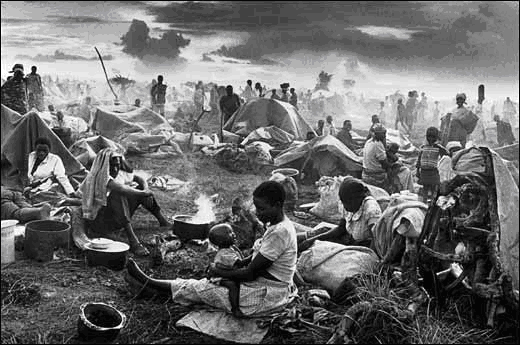
Murigande said representatives of both governments held comprehensive discussions on the matter last June in Kigali, after which it was decided that the repatriation process would be finalised in September 2007.
The minister said that the Kigali administration had already sent a delegation to sensitise the Rwandans about the impending repatriation.
He said the delegation scouted different parts of Tanzania that are occupied by Rwandan refugees, particularly Karagwe District for 15 days, urging them to return home voluntarily.
Most of these refugees are opposed to the move because the areas they currently occupy are vast enough for their animals to graze, a drastic difference from the situation in Rwanda.
Murigande said both governments had agreed to let the process take that long, because of other activities involved. Such activities involve mass vaccination of the refugees’ animals against cattle diseases.
Over the past few years the government stepped up efforts against cattle diseases such as foot and mouth, with serious restrictions for the entry of cattle and dairy products into the country.
Without delving into the details, the minister said an inter-ministerial committee between the ministries of Infrastructure, Education, and Lands and Environment has already decided on the areas in which to resettle the refugees upon return.
A recent World Food Programme emergency report indicates that the number of expelled Rwandan refugees from Tanzania was soaring each month.
The August 25, 2006 report said that 610 returnees were still accommodated in 171 temporary tent stands, and that 520 had been settled.
Murigande said the expulsions are in no way related to the relations between the two countries. Tanzania had the right to expel illegal immigrants.
“Tanzania claims that there are people who have been living on her territory illegally and they have decided to send them away. So, as a sovereign state, this decision cannot be overlooked,” he said.
He however could not rule out a possibility of some opportunists using the situation to distabilise legal settlers, and robbing them of their property.
The majority of the expelled Rwandans say their cattle and other assets were confiscated from them by Tanzanians during the process.
The two governments set up a joint team to study the returnees’ complaints and a report is yet to be released.
The 9 challenges facing Africa.
Posted On Friday, June 29, 2007 at at Friday, June 29, 2007 by UnknownAmerican policy is based overwhelmingly on the idea that Africa can lift itself out of extreme poverty through its own efforts, that aid is largely misused because of corruption, and that the United States already gives generous amounts. This is wrong on all counts: Africa is trapped in poverty, many countries are well poised to use aid effectively, and America’s contribution is tiny relative to Africa’s needs, America’s promises and America’s wealth.
Africa suffers simultaneously from three challenges that trap it in poverty. First, Africa does not grow enough food. Unlike Asia, Africa did not have a Green Revolution in food production. In 1965, India averaged 854 kilograms of grain per hectare in use, while sub-Saharan Africa averaged almost the same, 773 kilograms per hectare. But by 2000, India was producing 2,293 kilograms per hectare, while Africa was producing only 1,118.
Third, Africa is economically isolated, owing to very poor infrastructure, large over-land distances and many landlocked countries. These geographical barriers keep much of Africa—especially rural Africa—out of the mainstream of international trade. Without the benefits of trade, much of rural Africa struggles at subsistence levels.
Bush might think that America is doing a lot to help overcome these problems, but the truth is that U.S. aid is minimal. Blair’s Africa Commission, as well as the U.N. Millennium Project, found that Africa needs about $50 billion per year in aid by 2010. America’s fair share of the total is about $15 billion per year. Yet official U.S. aid to Africa is only $3 billion per year, and much of that covers salaries for American consultants rather than investments in Africa’s needs.
This tragically small sum amounts to just three cents for every $100 of U.S. gross national product, which is less than two days of U.S. military spending.
Not only is U.S. aid a tiny fraction of what it should be, but American explanations for the lack of aid are wrong. Bush and others imply that Africa wastes the aid through corruption. But impoverished and slow-growing African countries like Ghana, Senegal, Mali, Benin and Malawi are ranked as having less corruption than fast-growing Asian countries like Vietnam, Bangladesh and Indonesia. Indeed, America’s own Millennium Challenge Account has already recognized such African countries for their strong governance. Good governance surely will help in Africa and elsewhere, but corruption should not be used as an excuse not to help Africa.
On hunger, the key is to help Africa achieve its own Green Revolution. Rich countries should help African farmers use improved seed varieties, more fertilizer and better water management, such as small-scale irrigation. The techniques are known, but Africa’s farmers are too poor to get started. With increased help to African farmers to grow more food (as opposed to shipping food aid from the United States), it would be possible to double or even triple crop yields.
On disease, malaria could be controlled by 2008 using proven, low-cost methods. But, again, Africa cannot afford them. The first goal should be to distribute long-lasting insecticide-treated bed nets to all of Africa’s rural poor within four years. The best estimates show that Africa needs about 300 million bed nets, and that the cost per net (including shipping) is around $10, for a sum of $3 billion. This cost would be spread over several years. In addition, Africa needs help with anti-malaria medicines, diagnostic equipment and training of community health workers.
On economic isolation, Africa needs help with the basics—roads and ports—but there is also an opportunity to “leapfrog” technology. Cell phones and Internet connectivity could reach all of Africa at low cost, ending the economic isolation of hundreds of millions of people. Some reasonable estimates put the cost at around $1 billion for an Africa-wide fiber-optic network that could bring Internet connectivity and telephone service across the continent’s villages and cities.
Africa is ready to break out of poverty—if the United States and other rich countries help. Europe appears poised to do more, while the United States appears to be the main obstacle. The G-8 Summit provides an opportunity for America, which will spend $500 billion on its military this year, to make a lasting—and certainly more cost-effective —contribution to global security by saving millions of lives in Africa and helping its people escape extreme poverty.
Ireland elects first black mayor.
Posted On at at Friday, June 29, 2007 by Unknown| Mr Adebari said it was a great honour |
Rotimi Adebari has been elected as first citizen of Portlaoise in County Laois.
The 43-year-old fled from Nigeria in 2000 because of religious persecution. After a few weeks, he and his family settled in the County Laois town.
In 2004, he was elected in the local elections as an independent councillor and on Thursday he became mayor.

The father-of-four has completed a masters degree in intercultural studies at Dublin City University and now works for Laois County Council, co-ordinating an integration project for local immigrants.
Mr Adebari said it was a great honour to become Portlaoise's first citizen, but that praise should be given to the people who elected him three years ago.
"Ireland is really changing. The immigrant community in the town has been growing, especially since the accession countries joined the European Union on enlargement in 2004," he said.
However, he added: "That is not to say that I did not have my own share of the prejudice that would be out there against maybe Nigerians, or immigrants or asylum seekers."
"But I don't let the attitude of a very small minority over-shadow the fact that the people are wonderful."Top 22 Pictures that Changed Our Lives.
Posted On Wednesday, June 27, 2007 at at Wednesday, June 27, 2007 by Unknown 


Was the 1979 Tanzania-Uganda war necessary?
Posted On Thursday, June 21, 2007 at at Thursday, June 21, 2007 by UnknownCORDIAL RELATIONS: President Museveni(L) being seen off by his Tanzania counterpart Jakaya Kikwete at Mwanza Airport. (File Phto)
That dubious claim that Amin was a butcher of tens of thousands is coming under closer scrutiny each week.
On April 11, 1979, a joint expeditionary force of the Tanzanian army backing several armed Ugandan exile groups of the Uganda National Liberation Army captured Kampala and the five-month war against the regime of President Idi Amin was over. Amin fell from power.
Hundreds of thousands of Ugandans celebrated the fall of Amin and that Easter Sunday churches were filled with worshippers grateful that an eight-year "reign of terror" had at last come to an end.
It bears debate, however, whether this war to remove Amin was worth the effort, money, and lives it took.
It is said that the Tanzanians fought to remove a dictator and yet today Ugandans are ruled by a leader whom some Tanzanian legislators denounced as a dictator in 2005 as the constitution was being amended to enable him rule beyond the then stipulated two terms.
It has also been widely claimed over the last 30 years that Amin's regime killed between 300,000 and 500,000 Ugandans. This was partly the basis for Tanzania's intervention in late 1978.
Economically, Uganda suffered in many ways during and especially immediately after this unnecessary war. The MiG-17 and MiG-21 fighter-bombers of the Uganda Airforce have never returned to the level at which they were in the 1970s.
A Ugandan peacekeeping contingent to Somalia would have been a formidable sight and no Somali would have dared fire mortars at a plane bringing Ugandan troops to Mogadishu, as happened last month when the UPDF arrived to take up position.
Today, the fact that the Ugandan army does not create a psychological deterrence and does not put fear into the armed Somali groups in Mogadishu, tells of what a shadow of an army Uganda has when compared with that of the 1970s.
Army and police barracks that were well-maintained in the 1970s are today some of the most embarrassingly dilapidated public housing estates in Uganda.
Masaka and Mbarara towns were bombarded during the war and although Mbarara has recovered somewhat since 1979, it has never returned to what it was in the 1970s and Masaka has never recovered at all from that 1979 destruction.
When Amin left power, Uganda did not have any foreign debt but today subsequent governments have still not cleared the debt owed to Tanzania. The war cost Tanzania over 500million dollars which, in 1979 terms, was a lot of money.
The Tanzanian government from time to time has reminded Uganda to repay that money, to no avail.
Instead, President Museveni finds it more important to order Bank of Uganda to pay off businessman Hassan Basajjabalaba's personal debts than to pay of the more important debt of gratitude to Tanzania.
It is said that Amin persecuted the Acholi and Langi tribes with a vengeance during his rule. But it is clear now that never have the people of Teso, Lango, and above all Acholi suffered and been economically and materially deprived as much in Uganda's history as they have since 1986.
The Acholi have spent 20 years in sub-human conditions, a situation that would have been and was unthinkable under Amin.
Less than two years after the war to oust Amin, Uganda was embroiled in a civil war again, launched by two guerrillas, Andrew Kayiira and Yoweri Museveni, who claimed that the root cause of Uganda's problems had been Amin and once he was removed from power, Uganda would return to sanity.
To this day, the Tanzanians do not seem to realise that they were fooled by the Ugandan exile groups to fight a war against Amin that had nothing to do with restoring democracy.
The first official casualty of the NRA war was not a UNLA soldier, but a Tanzanian sentry standing guard at the quarter guard at the Kabamba army barracks on February 6, 1981.
In March 1979, the Libyan strongman Colonel Muammar Gaddafi sent a contingent of Libyan soldiers to help shore up the beleagured regime of Amin. The Tanzanians fought these Libyans, many were killed, and Tripoli was humiliated.
Libya then embarked on an anti-Tanzania diplomatic campaign throughout the Arab and Islamic world in the 1970s and Tanzania suffered for it in a boycott by some Arab countries.
But just three years after 1979, Kayiira and Museveni were already getting arms and financial support from Gaddafi, much to the irritation and dismay of the Tanzanians.
In 2005, during the debate within Uganda over the extension of the term in office of President Museveni, several Tanzanian members of parliament angrily denounced Museveni and the NRM regime over breeding dictatorship in Uganda, the removal of which had been the primary reason for Tanzania's costly war of 1978 and 1979.
That is where the story ends --- after all the wasted resources, lives, and time fighting Amin, Uganda is back to square one, a war that was utterly unnecessary. That is how ironic history can be.
Top 25 Censored Stories of 2006.
Posted On Saturday, June 16, 2007 at at Saturday, June 16, 2007 by UnknownTop 25 Censored Stories of 2006
#1 Bush Administration Moves to Eliminate Open Government
#2 Media Coverage Fails on Iraq: Fallujah and the Civilian Death#3 Another Year of Distorted Election Coverage
#4 Surveillance Society Quietly Moves In
#5 U.S. Uses Tsunami to Military Advantage in Southeast Asia
#6 The Real Oil for Food Scam#7 Journalists Face Unprecedented Dangers to Life and Livelihood
#8 Iraqi Farmers Threatened By Bremer’s Mandates
#9 Iran’s New Oil Trade System Challenges U.S. Currency
#10 Mountaintop Removal Threatens Ecosystem and Economy
#11 Universal Mental Screening Program Usurps Parental Rights
#12 Military in Iraq Contracts Human Rights Violators
#13 Rich Countries Fail to Live up to Global Pledges
#14 Corporations Win Big on Tort Reform, Justice Suffers
#15 Conservative Plan to Override Academic Freedom in the Classroom
#16 U.S. Plans for Hemispheric Integration Include Canada
#17 U.S. Uses South American Military Bases to Expand Control of the Region
#18 Little Known Stock Fraud Could Weaken U.S. Economy
#19 Child Wards of the State Used in AIDS Experiments
#20 American Indians Sue for Resources; Compensation Provided to Others
#21 New Immigration Plan Favors Business Over People
#22 Nanotechnology Offers Exciting Possibilities But Health Effects Need Scrutiny
#23 Plight of Palestinian Child Detainees Highlights Global Problem
#24 Ethiopian Indigenous Victims of Corporate and Government Resource Aspirations
#25 Homeland Security Was Designed to Fail
Kenya's Wealth in Foreign hands.
Posted On Wednesday, June 13, 2007 at at Wednesday, June 13, 2007 by UnknownKENYA’S WEALTH IN FOREIGN HANDS
If Kenya were a cake to be shared out,Kenyans would only lay claim to 31 per cent of the country’s total wealth. The rest would go to foreigners. Agriculture,tourism and banking,which combined bring in the country’s largest earnings,are in foreign hands. Last year,tea,tourism,flowers and coffee earned the country Sh140 billion,nearly half of the annual national budget. Of this money,only 31 per cent ended up in the country - as tax and real earnings to the nationals. And shareholding in the richest 20 companies that trade at the Nairobi Stock Exchange is foreign.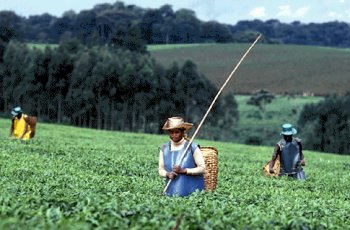
Tea growing,which earned the country Sh43.5 billion last year,is concentrated in the hands of six leading agricultural companies whose shareholding is largely foreign. Up to 78 per cent of earnings from tea went,therefore,to foreigners - leaving the balance for Kenyans. The Big Six in the tea sector are Unilever Tea Kenya,Kakuzi Ltd,Williamson Tea Company,Kapchorua Tea,Limuru Tea Company and Sasini Coffee and Tea. The British-owned Brooke Bond Group holds 43.1 million shares of the total 48.8 million shares issued in Univeler Tea Kenya . The same group owns 54 per cent of the total 3.9 million shares issued in Limuru Tea Company. In Kakuzi Ltd,foreigners have a total shareholding of 68.3 per cent of the total 19.6 million shares issued. They hold the shares through Bordure Ltd and Lintak Investment Ltd,with 35.1 and 33.2 per cent shareholding,respectively.
Britain’s Williamson family has a controlling majority shareholding in both Williamson Tea and Kapchorua Tea companies. In Williamson Tea,it holds 67.2 per cent of the total 8.8 million shares issued through their company,Ngong Tea Holding PLC. In Kapchorua tea,they hold 40 per cent of the 3.9 million shares issued. Sasini Tea and Coffee Ltd is 87.3 per cent owned by business magnate Naushad Merali,a Kenyan. Merali’s companies hold his shares in these businesses: Legend Investments Ltd (51.7 per cent),East African Batteries (18.7 per cent), Yana Towers (15.9 per cent) and Swan Estates (1.04 per cent).
The reinvigorated tourism sector,which earned Sh42 billion last year,is also foreign-owned. And just as the Sh43.5 billion earnings from tea sector ended up in foreign pockets,so did the Sh42 billion that came from tourism. Tourism earnings went into three directions: Hotels,airlines,and travel/booking agents,in that order. Of Kenya ’s 290,000-plus tourist hotel bed spaces,foreign hoteliers own 74.3 per cent of it. Tour flights to Kenya are entirely in the hands of foreign airlines. It is all the more foreign-dominated in the traditional tourist peak periods of Easter and Christmas,when there are no scheduled flights to Kenya ’s tourist hub of Mombasa . During the two seasons,tourists arrive in Mombasa in chartered jets arranged by European tour operators.
Foreign companies stationed in European and American capitals also entirely control hotel bookings and transfers. Where internal travel is concerned,foreigners too,dominate by owning 7 of the 11 leading local tour travel firms. At the end of the day,tourism in Kenya remains a foreigners’ enclave with indigenous Kenyans left to scratch the surface on petty trades like selling curios and prostitution. After years of lobbying,last year the European Union set aside Sh250 million to economically empower indigenous Kenyans to get a fair share of the lucrative industry. Seven projects were targeted to tilt the balance in a programme called Tourism Diversification and Empowerment Project. But a spokesman at the Nairobi EU office said the money is yet to be released as project proposals submitted are still under evaluation. The only hotel chain listed on the Nairobi Stock Exchange is the TPS Serena. The Aga Khan Fund for Economic Development holds the company’s majority shareholding through its company,TPS Holdings Limited.
Horticulture,which earned Kenya Sh28.2 billion last year,is the country’s third largest foreign exchange earner. It,too,is a foreigners’ affair. Indigenous Kenyans mainly come in as casual labourers on the flower farms. Of the 44 certified companies dealing with horticulture products,26 are foreign-owned. But an even bigger irony is that the leading 10 players in the industry - all foreign-owned - bag 83 per cent of the total income from the sector. Flower farming (floriculture) is the key plank in Kenya ’s agriculture sector. Seventy six per cent of Kenya ’s total flower production is concentrated in foreign-owned flowers farms around the Naivasha area. The big three are Homegrown,Sulmac and Oserian. Late last year, Kenya overtook Israel and Columbia as leading exporters of cut flowers. But you would not know that from the world’s leading flower auctions in Amsterdam and London . Why?
Foreign flower exporters in Kenya have registered their companies abroad - mainly in Amsterdam - and sell flowers they have grown in Kenya under a foreign label. In that case,while flowers from a local company are sold in Amsterdam as flowers from Kenya ,Dutch companies growing their flowers in Naivasha sell theirs as flowers from Holland . The consequence of it is that flowers owned by Dutch companies receive preferential treatment at the auction,including exemption from the strict EU-imposed export rules. Flower auctions in Amsterdam and London account for 65 and 25 per cent of Kenya flower sales respectively. Of the approximate 60,000 tonnes of flowers exported from Kenya last year,37,000 tonnes were sold in Amsterdam and London auctions as flowers from Holland . The statistics can make it look like the entire flower industry in Kenya is one big conspiracy against indigenous people. Foreign air charters,the only ones used in flower transport,charge the highest rates in Nairobi . Freight charges on flowers from Kenya are twice those in the capitals of Kenya ’s nearest competitors Israel , Columbia and Costa Rica . There are also 40 to 45 per cent higher than in Egypt and South Africa , Kenya ’s two biggest competitors on the continent. At $400 a day,inspection and storage charges at Jomo Kenyatta International Airport are the highest in the world. So is the freight charge of $1.85-$2.2 per stem.
Flowers sold in Kenya ’s name are inspected stem by stem at the JKIA at the cost of 12 Euro cents a stem. Those grown in Kenya but marketed by overseas-accredited companies are only inspected in bulk. On average,it costs upwards of $1 million to set up a typical flower farm on a half acre spread,which in turn brings in a $50,000 a year. Kenya’s fourth leading export earner,coffee,is equally depressing on the ownership scale. The majority of small-scale coffee growers in Kenya sell coffee raw from the farm,earning less than 10 per cent of what the finished end product earns in foreign markets and in a foreign label. Though touted as an agricultural country,the other large-scale agricultural activities in Kenya are also foreign-owned. Rea-Vipingo Plantations,which deals mainly in sisal and dairy farming is 77 per cent owned by the Robinson family of England . They hold the shares through REA Holdings PLC,Unibuckle Holdings Ltd and REA Trading Ltd.
Del Monte,world famous for pineapple products,is entirely a French affair and sells its products with the label “Made-in-France”. The question of who owns Kenya ’s wealth sticks out like a sore thumb in the banking sector. The leading two banks with a combined market share of 71.4 per cent are Barclays Bank of Kenya and the Standard Chartered. They are foreign-owned. Barclays Bank plc of London owns 68 per cent stake in Barclays Bank of Kenya . Standard Bank Africa,a London outfit,in turn owns 81 per cent shareholding in Standard Chartered Bank. To avoid domination by foreign banks, Nigeria and South Africa enacted laws on percentages of shareholding a foreign bank could own. Foreign ownership is also the same cord that runs through key blue chip companies listed on the Nairobi Stock Exchange. At the East African Breweries,British-owned Guinness plc holds 63.5 per cent of the total equity,leaving Kenyans to scramble for the rest. Guinness shares are held in the names of Diageo Kenya Ltd and Diageo Netherlands B.V.
In the Nation Media Group,the Aga Khan holds 28.2 million shares of the 35.6 million shares issued. The Aga Khan’s shares are held in the names of the Aga Khan Fund for Economic Development and Amin Nanji Juma. In Kenya Airways,Dutch company,KLM,holds 40.6 per cent equity. In Total Kenya Ltd,French companies Total Outre-mer and Elf Oil Kenya Ltd,own 77 per cent of the total shareholding,while in BAT Kenya Ltd, Molensteegh Investment BV of London ,holds 68 per cent of the total shareholding. The question of who owns Kenya ’s wealth generated a national debate in 1968 when the National Council of Churches of Kenya published a paper entitled: “Who Owns Kenya ’s Industry?” In the paper,the late Anglican Bishop,the Rev Henry Okullu,regretted that five years into independence,”the compass needle had not moved in the direction of indigenous ownership of Kenya ’s wealth.” Thirty-seven years later,the Rev Okullu would turn in his grave to note that the needle has drifted even further away.
Prof Ali Mazrui questioned Tanzania’s historical accounts in relation to Nyerere’s public policies.
Posted On Friday, June 08, 2007 at at Friday, June 08, 2007 by UnknownIn a thought-provoking article in The Sunday Standard on December 24, 2006, Prof Ali Mazrui questioned Tanzania’s historical accounts especially in relation to the late Tanzanian President Mwalimu Julius Kambarage Nyerere’s public policy decisions.In an earlier article that was published in Britain titled: “Tanzania versus East Africa: A Case of Unwitting Federal Sabotage” Mazrui argued that Tanzania’s pursuance of socialism and self-reliance unintentionally destroyed the prospects for an East African Federation.
In most historical accounts Nyerere is said to have been willing to delay Tanganyika’s independence if it would lead to an East African Federation.
The extent to which Nyerere’s ujamaa (socialism) policy contributed to the collapse of the East African Community (EAC) is seldom mentioned.
Historians in Tanzania have not considered whether the country’s divergent policies were the main reason beh
Most historians blame former Ugandan dictator, the late Idi Amin, for the collapse of the EAC. In our distorted historical perspective Tanzania’ s hands are clean!
Mazrui left Nyerere’s Pan-Africanist image in tatters when he claimed the union between Tanganyika and Zanzibar was initiated by the West to protect Anglo-American cold war interests. He dismissed historical accounts that it was a home grown initiative to build one Africa.
Mazrui suggested that Nyerere was not amused by the contention that the union was part of the cold war strategy and not a case for Pan-Africanism.
Our history books are inundated with information on how our shared history, common security interests, economic needs and a desire for one Africa guided the unification of Tanganyika with Zanzibar.
But Mazrui argued that the then US President Lyndon Johnston and British Prime Minister Sir Alec Douglas feared that the archipelago of Zanzibar would be converted by the Soviets into a communist nation with the suport of the Soviet Union and Cuba. This assertion cannot be found any where in our history books.
The books briefly mention that foreign manipulations of Zanzibar were detrimental to mainland interests without singling out machinations of the Soviet Union.
A foreign-initiated unification of Tanganyika and Zanzibar meant that external interests were paramount rather than the need to respond to local interests.
This may explain why the much envisaged benefits of the union are nowhere in sight.
But the professor must account for espousing contradictory thoughts in his column.
His suggestion that Zanzibar was more communism-prone than mainland Tanganyika is not plausible. Zanzibar, which was ruled by the Sultanate of Zanzibar, was feudal in nature. It was ruled by feudalism apologists who were unlikely to change policy direction. The Zanzibar Marxists, who were determined to wrestle power from the rulers of the time, depended on the Sultan’s moral and financial support.
In other words whichever direction the wind of political change in Zanzibar blew the colonial legacy of the economic blueprint of the Sultan would be firmly unaltered.
Socialist Tanganyika was more likely to fall under Soviets control and be a worry to Western hegemonies than Zanzibar. It is likely that the unity was brought about by the confusion in Zanzibar and Tanganyika’s experimentation with the virtues of an egalitarian society.
World Famous Photos.
Posted On Wednesday, June 06, 2007 at at Wednesday, June 06, 2007 by UnknownOn July 22, 1975, photograph Stanley J. Forman working for the Boston Herald American newspaper when a police scanner picked up an emergency: “Fire on Marlborough Street!”
Climbed atop the fire truck, Forman shot the picture of a young woman, Diana Bryant, and a very young girl, Tiare Jones when they fell helplessly. Diana Bryant was pronounced dead at the scene. The young girl lived. Despite a heroic effort, O’Neil knew he had been just seconds away from saving the lives of both.
Photo coverage from the tragic event garnered Stanley Forman a Pulitzer Prize. But more important, his work paved the way for Boston and other states to mandate tougher fire safety codes.

An experimental – and controversial – procedure for treating a crippling birth defect in the womb offered Trish and Mike Switzer the only chance that their daughter would walk like other children. But the fetal surgery posed a fatal dilemma: Their baby could die before she was born.
Photographer Max Aguilera saiud about this photo: “During a spina bifida corrective procedure at twenty-one weeks in utero, Samuel thrusts his tiny hand out of the surgical opening of his mother’s uterus. As the doctor lifts his hand, Samuel reacts to the touch and squeezes the doctor’s finger. As if testing for strength, the doctor shakes the tiny fist. Samuel held firm. At that moment, I took this “Fetal Hand Grasp” photo.
As a photojournalist, my job is to tell stories through pictures. The experience of taking this photograph has had a profound effect on me, and I’m proud to share this moment with you”
I’m not really sure about this but from what i remember, after this picture abortions were banned in UK. Please correct me if i’m wrong.
![Born Twice [1999]](https://lh3.googleusercontent.com/blogger_img_proxy/AEn0k_u-357WLuvVeT9KeBTin7ocHMMPXNjY4nqFdIMxEAPyPWFfxLr5t7una6DyPlQRPGKC04HmrSeQQN3DzhmCvlqZIRATieylG_W-V6KskFetzncODtfyzcW98nCjNWHuQPGyW_gtvUm1fYq4PqzRrIQ14hZtGA=s0-d "Born Twice [1999]")
The girl in the picture is Phan Thị Kim Phúc also known as Kim Phuc (born in 1963), a nine-year old running naked and severely burned on her back by a napalm atack.
Photographer Huynh Cong Ut, known by his colleagues as Nick, was working there as a photo journalist for Associated Press at the time and took a number of photographs of the villagers trying to escape the napalm. This one, epitomising the savagery and tragedy of the conflict, won him the coveted Pulitzer Prize and became one of the most published photos of the Vietnam war.
The boy is her older brother Tam who survived the attack but lost an eye. Ut (the photographer) poured water onto the young girl and took her and some of the other children to a hospital near Saigon where she spent fourteen months recovering from the horrific burns to her skin.
Later, the girl studied medicine and now she; a UNESCO member living in Canada.

The photo is the “Pulitzer Prize‿ winning photo taken in 1994 during the Sudan Famine.
The picture depicts stricken child crawling towards an United Nations food camp, located a kilometer away.
The vulture is waiting for the child to die so that it can eat him. This picture shocked the whole world. No one knows what happened to the child, including the photographer Kevin Carter who
left the place as soon as the photograph was taken.
Three months later he committed suicide due to depression.

It is said this picture killed an industry. On May 6, 1937, the Hindenburg dirigible exploded killing 35 of the 97 people aboard. The incident killed the zeppelin travel industry, which was, at the time, considered the safest mode of air travel available. The funny thing is that it wasn’t the worst zeppelin accident but the only one cought on a picture…
![Hindenburg dirigible disaster [1937]](https://lh3.googleusercontent.com/blogger_img_proxy/AEn0k_siKc9qFOC_IF01mRzg9VvwTprg9h1FxsKZ81x9yQcyWf_G-92Y0GJYcht5_BOIsZAWlQSrCnbJmZ4eApMuZOIBUb2NEkx9rwt8uaYzLt0J4R9W1xJhSa7n5lcZavVwoyaPlcD_N_UzFwbNHTlXh1kOF1sh_dO4zv8=s0-d)
Omayra Sánchez was one of the 25,000 victims of the Nevado del Ruiz (Colombia) volcano which erupted on November 14, 1985. The 13-year old had been trapped in water and concrete for 3 days. The picture was taken shortly before she died and it caused controversy due to the photographer’s work and the Colombian government’s inaction in the midst of the tragedy, when it was published worldwide after the young girl’s death.
![Omayra Sánchez [1985]](https://lh3.googleusercontent.com/blogger_img_proxy/AEn0k_tjfJJXXSjg8_xPpasjako8U95StwQdajyR14U2xes7oX576O_Wfyi_N5uIAdwTEys2uPfcwLV0mcyWqJtNbgqjZn2BCBNtDDKA8IhL8EdcEzTIZc4wwoqlU_hh1wCwUWhIXXD0W6qTqJCuML2G=s0-d)
June 11, 1963, Thich Quang Duc, a Buddhist monk from Vietnam, burned himself to death at a busy intersection in downtown Saigon to bring attention to the repressive policies of the Catholic Diem regime that controlled the South Vietnamese government at the time. Buddhist monks asked the regime to lift its ban on flying the traditional Buddhist flag, to grant Buddhism the same rights as Catholicism, to stop detaining Buddhists and to give Buddhist monks and nuns the right to practice and spread their religion.
While burning Thich Quang Duc never moved a muscle.
![Burning Monk - The Self-Immolation [1963]](https://lh3.googleusercontent.com/blogger_img_proxy/AEn0k_s64UQGrdv8YlDd9X_i6Mh_vlYxjRESgHeGZ_j8DmxTwWSwAUk617zEPqd8iOpvgXRNOOVlqeZTtV-e0iG9U8YHc2QJapQBBH369h347QIVU6f8R0mAYejk39zlGmglnkWImyNh_DmZVuVtAoMybB-Od1U=s0-d)
This picture won the Pulitzer Breaking News Photography 2007 award. Photo’s citation reads, “Awarded to Oded Balilty of The Associated Press for his powerful photograph of a lone Jewish woman defying Israeli security forces as they remove illegal settlers in the West Bank.
![The Power of One [2007]](https://lh3.googleusercontent.com/blogger_img_proxy/AEn0k_uKjqqSQnVuljx_5nryUsZujM98kxcu74mmF7w-k4TFgbc-DXYViWcuc_okxfYVm9X1pKqYIJ37LEWYxAYbISXU5mbrSIu9zeEXXPPAmGA_BLu6uL7Og0nX20TxmKqLT-qkZwWzzR5xOZWtyg=s0-d)
This picture is one of the most famous moments in sporting history! It shows Cassius Clay knocking out Sonny Liston (former heavy weight champion) in the first minute of the first round, in a rematch (Muhammad won the match the year before after Sonny resigned to defeat complaining of a shoulder injury).
Speculations circulated about Liston’s fall, many spectators considered the bout fixed, even the FBI investigated the case. Some say while preparing for the fight, Liston was visited by Black Muslims who threatened to kill his daughter Eleanor if he should win the rematch, others say Liston lied down for money.
![Muhammad Ali versus Sonny Liston [1965]](https://lh3.googleusercontent.com/blogger_img_proxy/AEn0k_tjIBjIW4AM3AvM9QwDYSZ8S3HQJc_9btneXZXkUJ5ClNSyNS40Hk_j0TVtZnUReDIlwTUtl4YRwri821Z0U_YJhqU4uczzROv0y4edOwEcbWZq9Zx6QFg-nDegFqXb3wL4uImF5kdMorcVBSDZRwd9iwEFlU8JGmy45IictENQsw=s0-d)
Picture was taken April 18, 1906. It is the most famous photo of the destruction of San Francisco by earthquake and fire on April 18, 1906. After his camera was damaged during the earthquake, Arnold Genthe borrowed a hand-held camera from George Kahn, his dealer, and started taking pictures of the disaster. The most memorable is this one, showing enormous clouds of smoke ominously approach, buildings’ facades collapsed from the quake, and residents standing and sitting in the street…

After capturing and executing Che in 1967, before bury him in a secret tomb, the executioners made a group photo with the body, to demonstrate the people that In Grande Che is dead. The picture actually made him a legend, his admirers said he had a forgiving look on his face and compared him with Jesus.

The tourist guy, is an Internet phenomenon consisting of a photograph of a touristPhotoshopped pictures after the September 11, 2001 attacks. The tourist was identified as Péter Guzli.
Soon after 9/11 an image showing a tourist while an airliner was about to hit the building beneath him circulated on the Internet. It was claimed that the picture came from a camera found in the debris at Ground Zero. The picture won a best 9/11 Photoshopped picture contest.

A Great Day in Harlem is a black and white group portrait of 57 jazz musicians.
Art Kane, a photographer working for Esquire magazine, took the picture at around 10 a.m. in the summer of 1958. The musicians had gathered on 126th Street, between Fifth and Madison Avenues in Harlem, New York City.
Jean Bach, recounted the story behind it in her 1994 documentary film, A Great Day in Harlem. The film was nominated in 1995 for an Academy Award for Documentary Feature.
The photo was also a key object in Steven Spielberg’s film, The Terminal.

Star forming pillars in the Eagle Nebula, as seen by the Hubble Space Telescope’s FPC2. These eerie, dark pillar-like structures are actually columns of cool interstellar hydrogen gas and dust that are also incubators for new stars. The pillars protrude from the interior wall of a dark molecular cloud like stalagmites from the floor of a cavern.

Soviet Union soldiers Raqymzhan Qoshqarbaev and Georgij Bulatov raising the flag on the roof of Reichstag building in Berlin, Germany in May, 1945.

The ‘Second Great Fire of London is commemorated in a famous photograph taken from the roof of the Daily Mail building by Herbert Mason, in which the dome of St Paul’s Cathedral rises above clouds of black smoke.

On July 20, 1969, Neil Armstrong put his left foot on the rocky Moon. It was the first human footprint on the Moon. They had taken TV cameras with them. The first footprints on the Moon will be there for a million years. There is no wind to blow them away.

Famous photograph of Che Guevara was taken on March 5, 1960 by Alberto Korda at a funeral service for victims of the La Coubre explosion, it was published seven years later. Che Guevara was 31 at the time of the photo.

Adolf Hitler visits Paris with architect Albert Speer (left) June 23, 1940

Raising the Flag on Iwo Jima is a historic photograph taken on February 23, 1945, by Joe Rosenthal. It depicts five United States Marines and a U.S. Navy corpsman raising the flag of the United States atop Mount Suribachi during the Battle of Iwo Jima in World War II.
The photograph was extremely popular, being reprinted in thousands of publications. Later, it became the only photograph to win the Pulitzer Prize for Photography in the same year as its publication, and ultimately came to be regarded as one of the most significant and recognizable images of the war, and possibly the most reproduced photograph of all times.

Actually this is the earliest surviving photograph, c. 1826. It required an eight-hour exposure, which resulted in sunlight on both sides of the buildings.

In 1901 Wilhelm Konrad Roentgen was the first recipient of the Nobel Prize for Physics, and he truly deserves his place in history because his discovery revolutionized the medical world. A series of experiments helped him notice that barium platinocyanide emits a fluorescent glow. Combining his observation with a photographic plate and his wife’s hand, he made the first X-ray photo, and thus, made it possible to look inside the human body without surgical intervention.
![First X-ray [1896]](https://lh3.googleusercontent.com/blogger_img_proxy/AEn0k_sk_HwLKEkKMz0OR66XlGCEU4K9Jzmi9J62FnvOEKOKjjfEPwD6NyqU97dcD3MuP7RP3r8ql0tPnB_BWHfdGdXnJ8ILVN8HGsyCwlVlI_yPMgsnu-7te-i2oH8x81JAJvU5Mk__b2a1Hx88Yo6iizYhx69DaNod=s0-d)
December 17, 1903 was the day humanity spread its wings and rose above the ground - for 12 seconds at first and by the end of the day for almost a minute – but it was a major breakthrough. Orville and Wilbur Wright, two bicycle mechanics from
![First Flight [1903]](https://lh3.googleusercontent.com/blogger_img_proxy/AEn0k_uja64kYcBmhL0Wl69OPpquihwXEE6tZczciSJBFSMv_TsbJ1JJYDrdf2wOLNXwFucH2qf4sRZoJ-4XlZ1udszTmMU57TgoeaRvoSGaFGJgiaHGQime_7i9OSuB9q9ePa4-dJExgmGSEa6zsj0uXXiYpA=s0-d)
Albert Einstein is probably one of the most popular figures of all times. He is considered a genius because he created the Theory of Relativity, and so, challenged
![Albert Einstein [1951]](https://lh3.googleusercontent.com/blogger_img_proxy/AEn0k_tauuqtsSFSPD-DRJJ2mtz-0xIKvaZbVF553wzhG7M0pFGuWceDmGNINdZM8qeXq3zuqBjwcVW161rdJZcxE7pn89Ich6s9dxFkIWT5ivPG0f5-HKOV0U26AQzf8w58y9kusOUafODg43N749nb6UX-ZHJiOw=s0-d)
A first for the general public, the picture of the “mushroom cloud is a very accurate approximation of the enormous quantity of energy spread below. The first atomic bomb, released on August 6 in
![Nagasaki [1945]](https://lh3.googleusercontent.com/blogger_img_proxy/AEn0k_u5qy6cVW-sWqLROGW24gQq3UsHlb0bq7y3yIIuDyAPl1CYmMpTwqEHx2alR6e-rGUdPS2A9QpUQCQ6_njcr9dAasrAN6CaHspMLVt41IztwG0Cwirx3Kr-vpNz7wKEAgP_uqNwcvuaXgpdxFCk=s0-d)
World War II was a harsh time for everyone, and of course, the most affected were those involved in combat. Taken away from their families and home lands, the American men were eager to hear from home, but, unfortunately, mail didn’t come very often, and when it did, it may have contained a Dear John letter.
Their salvation appeared in 1942 with Betty Grable – her beauty, charm and sexy legs reminded the boys what they were fighting for, and so, the war became a little less unbearable.
![Betty Grable [1942]](https://lh3.googleusercontent.com/blogger_img_proxy/AEn0k_sP7j1ovyWyCYb1fSUBk-lkrZvHTnzvjxELOd2e226wAdA5kxichx5fazauVV0L1iApIhVvoBGxxtRCC3KJZuUfhSfn6h83bIL4hOGyC9_FAcxNt-QuFVLQDBN0ATFnLLhpO5XaIfW90VoJEziNEHwFMA=s0-d)
This is probably the most famous picture you know. This is the picture of a student who tries to stop the tanks in Tiananmen Square standing in front of them. The tank driver didn’t crush the man with the bags but shortly after, the square filled with blood. The photo showed the Chinese that there is hope. However, China is still controlled by a communist regime.

This is a famous picture, taken in 1930, showing tho young black men accused of raping a white girl, hanged by a mob of 10,000 white men. The mob took them by force from the county jailhouse. Another black man was saved from lynching by the girl’s uncle who said he was innocent. Even if lynching photos were designed to boost white supremacy, the tortured bodies and grotesquely happy crowds ended up revolting many.


