


The Apocryphical Book of Enoch :The Lost Text
Posted On Tuesday, July 10, 2007 at at Tuesday, July 10, 2007 by UnknownThe Apocryphical Book of Enoch
The Lost Text
“One of the most important apocryphic works of the Second Temple Period is Enoch.”
- Milik, Jazef. T., ed. The Books of Enoch: Aramaic Fragments of Qumran Cave 4
The Book of Enoch is “an ancient composition known from two sets of versions, an Ethiopic one that scholars identify as ‘1 Enoch’, and a Slavonic version that is identified as ‘2 Enoch’, and which is also known as The Book of the Secrets of Enoch. Both versions, of which copied manuscripts have been found mostly in Greek and Latin translations, are based on early sources that enlarged on the short biblical mention that Enoch, the seventh Patriarch after Adam, did not die because, at age 365, ‘he walked with God’ - taken heavenward to join the deity.”
- Zecharia Sitchin, When Time Began
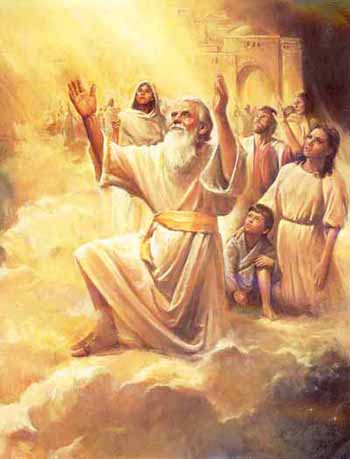
- David Conway, Ritual Magic
“The Book of Enoch is a pseudoepigraphal work (a work that claims to be by a biblical character). The Book of Enoch was not included in either the Hebrew or most Christian biblical canons, but could have been considered a sacred text by the sectarians. The original Aramaic version was lost until the Dead Sea fragments were discovered.”
“The original language of most of this work was, in all likelihood, Aramaic (an early Semitic language). Although the original version was lost in antiquity, portions of a Greek translation were discovered in Egypt and quotations were known from the Church Fathers. The discovery of the texts from Qumran Cave 4 has finally provided parts of the Aramaic original. …Humankind is called on to observe how unchanging nature follows God’s will.”
- Milik, Jazef. T., ed. The Books of Enoch: Aramaic Fragments of Qumran Cave 4
Although the Book of Enoch is considered as apocryphal, it was clearly known to early Christian writers as the following quote from 1 Enoch 1:9 indicates:
“In the seventh (generation) from Adam Enoch also prophesied these things, saying: ‘Behold, the Lord came with his holy myriads, to execute judgment on all, and to convict all the ungodly of all their ungodly deeds which they have committed in such an ungodly way, and of all the harsh things which ungodly sinners spoke against him’.”
- Jude 14-15
“Prior to the eighteenth century, scholars had believed the Book of Enoch to be irretrievably lost: composed long before the birth of Christ, and considered to be one of the most important pieces of Jewish mystical literature, it was only known from fragments and from references to it in other texts. James Bruce changed all this by procuring several copies of the missing work during his stay in Ethiopia. These were the first complete editions of the Book of Enoch ever to be seen in Europe.
- Graham Hancock, The Sign and the Seal
The Patriarch Enoch
“According to the biblical narrative (Genesis 5:21-24), Enoch lived only 365 years (far less than the other patriarchs in the period before the Flood). Enoch ‘walked with God; then he was no more for God took him’.”
- Milik, Jazef. T., ed. The Books of Enoch: Aramaic Fragments of Qumran Cave 4
“According to Sumerian chronicles of the earlier times, it was at Eridu’s temple that Enki, as guardian of the secrets of all scientific knowledge, kept the ME’s - tabletlike objects on which the scientific data were inscribed. One of the Sumerian texts details how the goddess Inanna (later known as Ishtar), wishing to give status to her ‘cult center’ Uruk (the biblical Erech), tricked Enki into giving her some of those divine formulas. Adapa, we find, was also nicknamed NUN.ME, meaning “He who can decipher the ME’s’. Even unto millennia later, in Assyrian times, the saying ‘Wise as Adapa’ meant that someone was exceedingly wise and knowledgeable….The ‘wide knowledge’ imparted by Enki to Adapa included writing, medicine, and - according to the astronomical series of tablets UD.SAR.ANUM.ENLILLA (’The Great Days of Amu and Enlil’) - knowledge of astronomy and astrology.”
“…It is almost certain that the biblical ‘Enoch’ was the equivalent of the Sumerian first priest, EN.ME.DUR.AN.KI (’High Priest of the ME’s of the Bond Heaven-Earth’), the man from the city Sippar taken heavenward to be taught the secrets of Heaven and Earth, of divination, and of the calendar. It was with him that the generations of astronomer-priests, of Keepers of the Secrets, began.”
- Zecharia Sitchin, When Time Began
“The learned savant
who guards the secrets of the gods
will bind his favored son with an oath
before Shamash and Adad…
and will instruct him in the secrets of the gods.”
“Thus was the line of priests created,
those who are allowed to approach Shamash and Adad.”
- Sumerian tablet (W. G. Lambert, Enmeduranki and Related Material)
“The legend [of Enoch] begins…with the Sumerian King List. This is a list of rulers before the Flood, and is preserved in several forms, including Berossus. Here one of the kings, often given as the seventh (as Enoch is in his list), is called Enmeduranki or Enmeduranna. He is generally associated with the city of Sippar, which was the home of the cult of the sun god Shamash. Moreover, in other texts this Enmeduranki was the first to be shown, by Adad and Shamash, three techniques of divination: pouring oil on water, inspecting a liver, and the use of a cedar (rod), whose function is still unclear. These were to be transmitted from generation to generation, and in fact became the property of the guild of baru, the major group of diviners in Babylon.
“These details show how the biblical portrait of Enoch may have been compiled from Enmeduranki: each is seventh in the antediluvian list; the biblical 365 preserves the affinity to the sun, rather than the sun god; walking with God (or perhaps, ‘angels’?) suggests the intimacy between god(s) and man. The final connection links not with Enmeduranki, but with a fish-man (apkallu), with which each of the first seven kings associated and from whom they learnt all kinds of knowledge. Enmeduranki’s apkallu, called Utu’abzu, is mentioned in another cuneiform text, where he is said to have ascended to heaven. This last link remains provisional, but at all events, the writer of Genesis 5:21-24 appears to either have created Enoch as a counterpart of Enmeduranki or, equally probably, to have alluded to an already existing Jewish tradition about Enoch, already modeled on the earlier figure.”
- John Rogerson and Philip Davies, The Old Testament World
“One cannot rule out the possibility that, as Enmduranki and Enoch, Adapa too was the seventh in a line of sages, the Sages of Eridu, and thus another version of the Sumerian memory echoed in the biblical Enoch record. According to this tale, seven Wise Men were trained in Eridu, Enki’s city; their epithets and particular knowledge varied from version to version. Rykle Borger, examining this tale in light of the Enoch traditions (’Die Beschworungsserie Bit Meshri und die Himmelfahrt Henochs’ in the Journal of Near Eastern Studies, vol. 33), was especially fascinated by the inscription on the third tablet of the series of Assyrian Oath Incantations. In it the name of each sage is given and his main call on fame is explained; it says thus of the seventh: ‘Uta-abzu, he who to heaven ascended’. Citing a second such text, R. Borger concluded that this seventh sage, whose name combined that of Utu/Shamash with the Lower World (Abzu) domain of Enki, was the Assyrian ‘Enoch’.
“According to the Assyrian references to the wisdom of Adapa, he composed a book of sciences titled U.SAR d ANUM d ENLILA - ‘Writings regarding Time; from divine Anu and divine Enlil’. Adapa, thus, is credited with writing Mankind’s first book of astronomy and the calendar.”
- Zecharia Sitchin, When Time Began
“And I saw there something horrible: I saw neither a heaven above nor a firmly founded earth, but a place chaotic and horrible. And there I saw seven stars of the heaven bound together in it, like great mountains and burning with fire. Then I said: ‘For what sin are they bound, and on what account have they been cast in hither?’ Then said Uriel, one of the holy angels, who was with me, and was chief over them, and said: ‘Enoch, why dost thou ask, and why art thou eager for the truth? These are of the number of the stars of heaven, which have transgressed the commandment of the Lord, and are bound here till ten thousand years, the time entailed by their sins, are consummated.’ And from thence I went to another place, which was still more horrible than the former, and I saw a horrible thing: a great fire there which burnt and blazed, and the place was cleft as far as the abyss, being full of great descending columns of fire: neither its extent or magnitude could I see, nor could I conjecture. Then I said: ‘How fearful is the place and how terrible to look upon!’ Then Uriel answered me, one of the holy angels who was with me, and said unto me: ‘Enoch, why hast thou such fear and affright?’ And I answered: ‘Because of this fearful place, and because of the spectacle of the pain.’ And he said unto me: ‘This place is the prison of the angels, and here they will be imprisoned for ever.’”
- Enoch 21:1-10
Enoch’s description of the punishment prepared for the fallen angels has clear parallels with the chaotic void in the Necronomicon.
“…The Book of Enoch has always been of great significance to Freemasons, and…certain rituals dating back to long before Bruce’s time [1730-1794] identified Enoch himself with Thoth, the Egyptian god of wisdom.”
- Graham Hancock, The Sign and the Seal
“Enoch was the first who invented books and different sorts of writing. The ancient Greeks declare that Enoch is the same as Mercury Trismegistus [Hermes], and that he taught the sons of men the art of building cities, and enacted some admirable laws…He discovered the knowledge of the Zodiac, and the course of the Planets; and he pointed out to the sons of men, that they should worship God, that they should fast, that they should pray, that they should give alms, votive offerings, and tenths. He reprobated abominable foods and drunkenness, and appointed festivals for sacrifices to the Sun, at each of the Zodiacal Signs.”
- Hebraeus
According to Masonic lore, Enoch was the inventor of writing, “that he taught men the art of building”, and that, before the flood, he “feared that the real secrets would be lost - to prevent which he concealed the grand Secret, engravnen on a white oriental porphyry stone, in the bowels of the earth.”
- Royal Masonic Cyclopaedia
“In his Antiquities of the Jews, Josephus writes that Adam had forewarned his descendants that sinful humanity would be destroyed by a deluge. In order to preserve their science and philosophy, the children of Seth therefore raised two pillars, one of brick and the other of stone, on which were inscribed the keys to their knowledge. The patriarch Enoch….also constructed an underground temple [at Moriah] consisting of nine vaults, one beneath the other, placing in the deepest vault a triangular tablet of gold bearing upon it the absolute and ineffable name of Deity. According to some accounts, Enoch made two golden deltas. The larger he placed upon the white cubical altar in the lowest vault and the smaller he gave into the keeping of his son, Methuselah, who did the actual construction work of the brick chambers according to the pattern revealed to his father by the Most High. In the form and arrangements of these vaults Enoch epitomized the nine spheres of the ancient Mysteries and the nine sacred strata of the earth through which the initiate must pass to reach the flaming Spirit dwelling in its central core.”
- Manly P. Hall, Masonic, Hermetic, Quabbalistic & Rosicrucian Symbolical Philosophy
Methuselah ” took the object back to Sippar. Enoch remained at Moriah, to become the old man on the mountain. He lived 365 years, according to Genesis, and then he died. Or did he vanish into thin air?”
- Brian , “ENOCH The Greatest Story Never Told “
Enoch’s “name signified in the Hebrew, INITIATE or INITIATOR. The legend of the columns, of granite and brass or bronze, erected by him, is probably symbolical. That of bronze, which survived the flood, is supposed to symbolize the mysteries, of which Masonry is the legitimate successor from the earliest times the custodian and depository of the great philosophical and religious truths, unknown to the world at large, and handed down from age to age by an unbroken current of tradition, embodied in symbols, emblems, and allegories.”
- General Albert Pike, Morals and Dogma
There was a substantial Zoroastrian Influence on Judaism when Jewish exiles were exposed to the Persian religion during the Babylonian captivity.
“Some Jews adopted Enochian tradition in Babylon during the Exile and brought it back to Canaan when Cyrus gave them leave to Return. The Enochian Jews were detested by the priesthood in Jerusalem, and they were forced to ‘flee’ into the desert before 300 BCE. Naturally, they supported the Maccabees during the uprising of 165 BCE. The Enochians at Qumran ‘updated’ the text to include Judah the Hammer in the big story.”
“The last of the Essence stragglers buried it [the secret book] in Cave IV at Qumran c.70 CE. The urban Christians and Jews of the Near East rejected it. The authors of the Apocalypse rewrote and retitled it, but they didn’t understand the heptadic structure of the original lines, the arrangement of sevens. (The Revelation of St John is pure gibberish, a sloppy rehash of Babylonian myths and legends.) Only the students of the Merkabah (in Babylonia) possessed the key to the Enochian mystery.”
- Brian , “ENOCH The Greatest Story Never Told “
The Secrets
“At that hour, that Son of Man was given a name, in the presence of the Lord of the Spirits, the Before-Time, even before the creation of the sun and the moon, before the creation of the stars, he was given a name in the presence of the Lord of the Spirits.”
- 1 Enoch 48:4
The Messiah “first appears as preexistent in the apocryphal First Book of Enoch, which was originally written in Hebrew or Aramaic about 150 BC. From that period on, the concept of the Messiah who was created in the six days of Creation, or even prior to them or who was born at variously stated subsequent dates and was then hidden to await his time, became a standard feature of Jewish Messianic eschatology.
- Raphael Patai, The Messiah Texts
“From the beginning the Son of Man was hidden, And the Most High has preserved him In the presence of His might, And revealed him to the elect.”
- 1 Enoch 62:7
“Written both as a personal testament and as a historic review, the Ethiopic Book of Enoch, whose earliest title was probably The Words of Enoch, describes his journey to Heaven as well as to the four corners of Earth.”
- Zecharia Sitchin, The Stairway to Heaven
“And after that I saw all the secrets of the heavens, and how the kingdom is divided, and how the actions of men are weighed in the balance. And there I saw the mansions of the elect and the mansions of the holy, and mine eyes saw there all the sinners being driven from thence which deny the name of the Lord of Spirits, and being dragged off: and they could not abide because of the punishment which proceeds from the Lord of Spirits.
And I saw the chambers of the sun and moon, whence they proceed and whither they come again, and their glorious return, and how one is superior to the other, and their stately orbit, and how they do not leave their orbit, and they add nothing to their orbit and they take nothing from it, and they keep faith with each other, in accordance with the oath by which they are bound together.”
- 1 Enoch 41:1-2, 5b -6a
“In the Book of Enoch it was the archangel Uriel (’God is my light’) who showed Enoch the secrets of the Sun (solstices and equinoxes, ’six portals’ in all) and the ‘laws of the Moon’ (including intercalation), and the twelve constellations of the stars, ‘all the workings of heaven’. And in the end of the schooling, Uriel gave Enoch - as Shamash and Adad had given Enmeduranki - ‘heavenly tablets’, instructing him to study them carefully and note ‘every individual fact’ therein. Returning to Earth, Enoch passed this knowledge to his old son, Methuselah.”
- Zecharia Sitchin, When Time Began
The knowledge granted Enoch included:
“All the workings of heaven, earth and the seas, and all the elements, their passages and goings and the thundering of the thunder, and of the Sun and the Moon; the goings and changing’s of the stars; the seasons, years, days, and hours.”
- The Book of the Secrets of Enoch
According to the The Book of the Secrets of Enoch, “it seems that when the prophet Enoch was ‘taken up’, he saw the air and then the ether. Then he reached the first heaven, where ‘two hundred angels rule the stars’ and where he saw a sea ‘greater than the earthly sea’.
“The second heaven was gloomy. In the third heaven, he saw the Tree of Life, with four streams, of honey, milk, oil, and wine, flowing from its roots. The Place of the Righteous is in this heaven and the Terrible Place where the wicked are tortured. There was also the ‘place on which God rests when he comes into Paradise’.
“In the fourth heaven, he saw luminaries, wondrous creatures, and the Host of the Lord. There were many ‘hosts’ in the fifth, and in the sixth he saw ‘bands of angels who study the revolutions of the stars’. Finally, in the seventh heaven he saw great angels and he got a distant glimpse of the Lord on His Throne.”
- Richard L. Thompson, Alien Identities
“I know a man in Christ who fourteen years ago was caught up to the third heaven. Whether it was in the body or out of the body I do not know - God knows. And I know that this man - whether in the body or apart from the body I do not know, but God knows - was caught up to Paradise. He heard inexpressible things, things that man is not permitted to tell.”
- 2 Corinthians 12:2-4 (the apostle Paul describing his own experience)
“Enoch’s third heaven…seems very similar to the region known as Ilavrta-varsa, which is described in the Fifth Canto of the Bhagavata Purana. Thus, in Ilavrta-varsa there are four gigantic trees, and four rivers flow from their roots, including a river of honey. There is also a city called Brahmapuri, which is visited by Lord Brahma and which may correspond to the ‘place on which God rests when he comes into Paradise’.”
The Venerable Bede, an eighth-century English theologian and historian, wrote that “the seven heavens are (1) the Air, (2) the Ether, (3) Olympus, (4) the Element of Fire, (5) the Firmament, (6) the Angelical Region, and (7) the Realm of the Trinity.”
“According to the Fifth Canto of the Bhagavata Purana, Brahmapuri and the residences of eight prominent Devas [administrators of the Universe] are situated on the top of a mountain in Ilavrta-varsa called Meru, and therefore Mount Meru corresponds to the Greek Olympus. Thus, if Ilavrta-varsa corresponds to Enoch’s third heaven, then it is also reasonable to say that this third heaven corresponds to the Greek Olympus.”
- Richard L. Thompson, Alien Identities

Warrior Peoples of East Africa 1840-1900.
Posted On Monday, July 09, 2007 at at Monday, July 09, 2007 by UnknownThe 10 Greatest Inventions
Posted On Saturday, July 07, 2007 at at Saturday, July 07, 2007 by Unknown1. The Mechanical Clock. Before this invention, time was inseparable from events, the main one being the Sun crossing the sky. Only local time existed, no universal river of time. If you agreed to meet someone at sunset, you had to say where, because the Sun is always setting somewhere. The sundial merely divided the Sun's daily journey into units, which meant the hour had no fixed length: it swelled and shrank with the seasons. Besides, no one carried a sundial around, so you never heard anyone say, "Can't talk now, I'm on the sundial." Then, mechanical clocks came around--gears, springs, pendulums, the works. Gradually, as these clocks all came to be coordinated, they created public time, a thing in itself: one single, universal current flowing everywhere throughout the universe, always at the same pace. People could now communicate with each other by coordinating to this universal frame of reference. Thus, clocks made factories, offices, schools, meetings, and appointments possible. The activities of millions could be meshed like, well, clockwork. And of course, what clocks made possible, they soon made necessary. In a clock-driven world, most of us are now either "on time," "ahead of schedule," or "running late."
2. The Toilet* and Modern Plumbing.* Go ahead. Laugh. Then try to imagine New York City without toilets. You can't. The ability to remove sewage from and bring clean water into places of dense human habitation makes the modern city possible. Without it, we'd still have cities, but not like the ones we know. A high-rise building would be impossible, really, without toilets and plumbing. Remove apartment buildings, office towers, and dense downtown cores from your picture of the world and you have to change the whole rest of your picture too, because the implications keep rippling.
3. The Printing Press. Unoriginal, I know, but still it's true. Gutenberg's press, with its movable type, launched publishing. In the short term, this made the Reformation possible by putting a Bible in the hands of anybody who wanted one. The Church lost its lock on truth, and the sovereign individual soon emerged as the key unit of Western society. In the longer term, publishing universalized literacy*. Before this invention, so few could read that, effectively, even those few lived in a world of oral tradition and memory. Humanity's consensual picture of reality was shaped by stories, told and retold. In this fluid world, if the big picture shifted, no one knew, because they had nothing to check it against. The proliferation of text fixed objective reality. Now, when two people disagree about what happened yesterday, they can look it up. Stories have survived, but merely as entertainment. Our modern collective picture of reality is founded on facts archived as text.
Technology Review senior editor Herb Brody picks the most important inventions of the past 1,000 years.*
A chart of great inventions, their inventors, and the year of the invention.
4. Immunization and Antibiotics. Three centuries ago, almost everyone died of infectious diseases. When the plague broke out in 1347, it killed nearly half of Europe--in about two years. When diseases such as smallpox reached North America, they reduced the indigenous population by about 90 percent within a century. As late as 1800, the leading cause of death in the West was tuberculosis. Hardly anyone died of old age back then, one reason why elders were revered. Today, elders are a dime a dozen: nothing unusual about surviving past 70. In the United States, 73 percent of people die of heart failure, cancer, and stroke. Chronic respiratory illnesses (related to smoking mostly) account for the fourth biggest slice of funeral business. It's a different world, folks.
5. The Telephone. Lots of people imagined the telephone before any telephone existed. Wouldn't it be cool, they said, if you could talk to someone in another city without leaving home? Once the device was invented, and businessmen had wrested it away from the inventors, the Network began to form. That's the actual invention--the Network. It enables anyone to talk to anyone anywhere at any given moment. So today, anyone's real-time group includes people not physically present, and they could be anywhere. The infrastructure took some time to develop, but the telephone implied all this from the start. Wireless cell phones don't change the core idea, they merely extend it. The Network continues to deepen.
6. The Electrical Grid. Electricity existed all along, but the system of devices needed to generate this force and distribute it to individual buildings was an invention, launched initially by Edison: He effectively turned electricity into a salable commodity and his Pearl Street station was the world's first electric power station. Nikola Tesla's invention of alternating current (AC) technology then made it possible to transmit electricity over long distances, leading to the nationwide grid we know today. Now, anyone in the West and throughout most of the world can tap into the grid to power everything from light bulbs to computers. We are, in fact, a social organism animated by electricity (and rendered conscious by the Network--see above).
7. The Automobile. Once cars were invented, roads were improved. Once roads were improved, cities sprouted suburbs, because people could now live in the country, yet work in the city. And thus we have become a nation of sprawl, rather than density. Furthermore, as cars grew popular, the oil industry boomed. Oil became a key to power and wealth--and one of the major factors for political and economic unrest in the Middle East. And here we are today.
8. The Television. Wherever a television set is on, it absorbs attention like no other piece of furniture. Jane Healy, in her book Endangered Minds, says television has changed the human brain itself. Our neural networks are not hardwired at birth but continue to develop for several years, new circuits forming in response to our first interactions with the environment. In much of the developed world, young children interact largely with television, so their neural networks hardwire to accommodate its warm, one-way, pacifying, activity-dampening stimulus.
9. The Computer. Okay, look. I'll come clean: My deepest, richest, most diverse, and rewarding relationship is with my computer. It plays games with me, tells me jokes, plays music to me, and does my taxes. I have great conversations with it, too. These conversations appear as e-mail and take on the personalities of supposed "friends," but the human embodiments of those "friends" are rarely with me. My concrete relationship is with this object on my desk (or in my lap). Anyway, when we can take the equivalent of our own brains onto an airplane with us in an attaché case, that's got to be shaping who we are in some important way.
10. Something New. So many seminal new inventions are coming into their own right now that one of them surely belongs on this list, but which one? The Internet represents the emergence of a global brain, separate from all the human cells contributing to it. Birth control will ultimately transform the role women play in society and history--and any transformation in who women are will force a transformation in men, too. Genetic engineering can potentially complete the metamorphosis of people into products. There's no telling what such an objectification of ourselves will do to us. And what about virtual reality? It's bidding to dissolve the age-old distinction between what is real and what is imaginary. I can't imagine how that will change our lives--no, really, I can't. Imagine.
20 Things You Didn't Know About U.S. Presidents.
Posted On Friday, July 06, 2007 at at Friday, July 06, 2007 by Unknown


10 Creatures You Didn't Know Were Poisonous
Posted On Thursday, July 05, 2007 at at Thursday, July 05, 2007 by UnknownSomeone once said, "What you don't know can't hurt you." Here's an argument against that: It is good to know if something is poisonous before you approach it (or it approaches you). We unearthed 10 unlikely poisonous creatures in order to give you a better chance next time you head into the wild kingdom.
Articles marked with a (*) are available to those with access to MSN Encarta Premium. Learn more.


10. Poison Arrow Frog: OK, the name kind of gives it away, but the poison arrow frog is only one of several amphibious species that secrete toxins from glands in its skin. The poison arrow frog uses its poison to kill potential predators. Native people of Central and South America use the toxin to poison the tips of arrows.
Top 10 African American Inventors
Posted On Wednesday, July 04, 2007 at at Wednesday, July 04, 2007 by UnknownYou can't get a blood transfusion, stop at a traffic signal, turn on a lamp, or even put on a pair of shoes without relying on technologies and devices first patented by African Americans. Here are just a few of the remarkable African American men and women who changed the way we live our lives.
Articles marked with an (*) are available to those with access to MSN Encarta Premium. Learn more.
The son of an engineer and a freed slave, American chemist and inventor Norbert Rillieux revolutionized the sugar industry by inventing a device to remove the water from the juices of sugarcane and sugar beets to produce dry sugar. Rillieux's invention enabled a purer sugar product, cost less money, and was far less dangerous to workers than previous methods.

Responsible for a remarkable 57 patents, American inventor Elijah McCoy is best known for inventing ingenious devices to lubricate heavy machinery automatically. McCoy's devices were so reliable that people often asked if machinery contained "the real McCoy," likely giving rise to this enduring expression.

Although he received seven patents for his inventions, mechanical draftsman and inventor Lewis Howard Latimer is best remembered for his key contributions to the incandescent light bulb. In 1881 Latimer patented an electric lamp with an inexpensive carbon filament and a threaded wooden socket. He later joined Thomas Alva Edison's team of inventors and wrote the first known book on electric lighting.
American artist and inventor Jan E. Matzeliger is most famous for designing and creating a machine that stretched leather shoe uppers around a foot-shaped model, or last. Before Matzeliger introduced his machine, highly skilled artisans lasted a maximum of 50 pairs of shoes a day. Matzeliger's automatic shoe lasting machine revolutionized the shoemaking industry, producing as many as 700 pairs of shoes in a single day.
Forced to quit school when he was only ten years old, American railroad engineer and inventor Granville T. Woods patented a remarkable 35 electrical and mechanical devices during his prolific career. Woods received his first patent in 1884 for a steam boiler furnace. His many later patents included a system that enabled telegraph lines to carry voice signals; an induction telegraph for sending messages to and from moving trains; and electromechanical and electromagnetic railway brakes.
Born on a Missouri farm to slave parents, George Washington Carver developed several hundred industrial uses for peanuts, sweet potatoes, and soybeans, and developed a new type of cotton known as Carver's hybrid. Carver is credited with introducing crop rotation to farmers in the southern United States, thereby revolutionizing the American farming industry.
Inventor and entrepreneur Sarah Walker created a line of hair-care products especially for black women. Walker, the daughter of Louisiana sharecroppers and nicknamed "Madame C.J.," was the first woman to sell products via mail order and to organize a nationwide membership of door-to-door agents. Madame C.J. is best remembered as one of the first American women of any race to become a millionaire through her own efforts.
The son of former slaves, businessman and inventor Garrett A. Morgan patented the first traffic signal in 1923. Morgan made national news when he used another of his inventions--the gas mask--to rescue several men trapped in a tunnel beneath Lake Erie. Morgan's mask was soon adopted by firemen around the world, and was also refined for use by the United States Army during World War I.
American businessman, inventor, and World War I veteran Frederick McKinley Jones is most remembered for introducing the first practical refrigeration system for trucks and railroad cars, a system that completely changed the food transport industry. Jones was responsible for a phenomenal 60 patents during his lifetime, 40 for refrigeration equipment alone.
10. Charles Richard Drew, M.D. (1904-1950)
American surgeon Charles Richard Drew conducted pioneering work in blood storage and transfusion techniques. Drew showed that blood plasma lasts longer than whole blood, a medical breakthrough that enabled the creation of the modern blood bank. In 1939, Dr. Drew used his new understanding of blood storage and transfusion to help establish the first blood banks to serve the Allied Forces in Europe during World War II. He went on to become the first director of the American Red Cross Blood Bank.

10 Reasons Why Namibia is an Absolute Must – See.
Posted On Monday, July 02, 2007 at at Monday, July 02, 2007 by Unknown- The Namib at 80 million years, is the oldest desert in the world.
- Easily accessible wilderness paradises such as the
- A diverse range of lodges, tented camps and guesthouses to suit all budgets
- The world’s highest sand dunes are at Sossusvlei in the
- Diverse cultures from San Bushman, Portuguese and German influences to the Himba people still living their age old traditional lifestyles. San paintings and engravings can be seen in the Kaokoveld and Damaraland
- The Namib and Damaraland offer remarkably clear skies for astronomers and keen star gazers
- The country offers superb birding, including the coastal ares. Good fishing is available from the banks of the Kavango and

Nigeria:amplifyd crew(nigeria's black eyed peas)
Posted On at at Monday, July 02, 2007 by UnknownTheir music is fun and eclectic with a strong hip-hop and naija influence….
Here are some promo shots (luv them!!!!)
_____________________________

_______________________________

_________________________________________


