


Genetic Nondiscrimination Bill Stalled in U.S Senate
Posted On Monday, November 19, 2007 at at Monday, November 19, 2007 by UnknownWith several private companies launching businesses to provide customers with unprecedented access to their genomes' secrets, legislation protecting people from genetic discrimination is more timely than ever. But Sen. Tom Coburn (R-Oklahama) is single-handedly stalling federal legislation to do just that.
The Senate passed earlier versions of the bill twice before, but they were blocked from coming up for House floor votes. This year, the House passed it by a bipartisan landslide, but Coburn has held up the legislation in the Senate, saying it could place too much strain on businesses.
"We're not really clear on what Coburn wants, because his excuses don't make sense," said the bill's original sponsor, Rep. Louise Slaughter (D-New York). "But if this bill got to a floor vote in the Senate, I think it'd pass almost unanimously."
 Coburn spokesman John Hart said his boss supports the intent of the Genetic Information Nondiscrimination Act, known as GINA. Coburn voted for a nearly identical bill in 2005, but now says the bill's language exposes employers to too much liability. Supporters of the bill see Coburn's new beef as another in a string of inconsequential objections to the legislation.
23andMe, Navigenics and Decode Genetics have recently launched programs to scan individual's genomes and provide access to the information online. Customers will have to spend a for 23andMe's service.
In the absence of federal legislation, most states provide some degree of protection against discrimination. Many have gone further, explicitly providing genetic-privacy protections. Alaskan law (.pdf), for example, says DNA samples are an individual's private property. Still, companies offering personal genome scans, as well as biotechs offering genetic diagnostic tests, worry that their businesses will not gain traction without a federal law.
Slaughter introduced GINA in the House 12 years ago, but Republican leadership repeatedly blocked a vote, even as it passed the Senate twice. Under this year's new Democratic majority, the House passed GINA, 420-3 (H.R. 493), and it appeared ready to sail through the Senate (S. 358). But Coburn, exercising a prerogative available to all senators, placed it on hold, which requires a supermajority of 60 senators just to bring the bill up for a relatively rare floor debate.
An internal memo obtained Thursday from Coburn's office said the senator's make-or-break objection was the possibility that an employer who provides health insurance for its workers could be sued both as an insurer and as an employer. That means employers could be hit for much higher damages than insurers.
Representative Slaughter said she'd never heard that particular objection from any company in 12 years of campaigning on behalf of GINA. "But it's pretty creative," she said.
Coburn is a physician. He picked up the nickname "Dr. No" from pundit George Will, because of his frequent contrarian positions and use of the hold prerogative. Coburn has consistently opposed bills that enable lawsuits against businesses and his fellow medical doctors.
The U.S. Chamber of Commerce and trade associations like the National Retail Federation are GINA's main opponents, claiming it would spur frivolous lawsuits.
Michael Eastman, executive director of labor policy at the U.S. Chamber of Commerce, applauded the Senator's move to stop the bill.
"Coburn has been willing to put his name out there," he said.

Opportunities in Kenya’s Communications sector
Posted On Friday, August 10, 2007 at at Friday, August 10, 2007 by UnknownOpportunities in Kenya’s Communications sector
Afrigator : A Social media site for Africa.
Posted On Wednesday, August 01, 2007 at at Wednesday, August 01, 2007 by UnknownAfrica's first social media aggregator tracks more than 1,000 Africa-related blogs, podcasts and news sites. Readers can rank individual posts and read them online. In May, Afrigator began using OpenID, a system that allows users to operate a single login at multiple websites.
CEO: Justin Hartman
Location: Johannesburg, South Africa
URL: afrigator.com
Launch: April 2007
Funding: $35,000 (angel investors)
Hands as a Calculator.
Posted On Tuesday, July 24, 2007 at at Tuesday, July 24, 2007 by UnknownHands as a calculator have many advantages over the pencil and paper methods in arithmetic. The students require no external device and can practice the procedures at any time or place. Rote memory of the addition and multiplication tables, facts that can not be visualized, is the most difficult memorization possible. Representing numbers with the hands provides the visuals needed to enable a much easier memorization process to occur. A good pedagogical approach is to have the students verify the addition and multiplication tables using their hands as a calculator.
Swahili Advanced Computer Applications (SACA).
Posted On at at Tuesday, July 24, 2007 by UnknownSwahili (or KiSwahili as it is known in Swahili) is the most widely spoken African language, as a first or additional language. As a consequence it is receiving some of the most attention with relation to use in information and communication technologies (ICTs).
This message is set up to facilitate communication about various technical initiatives, projects, and research. For the moment it will serve as an experiment to see if this format can serve as an easily accessible place for exchange of information on and links to research and projects for advanced computer applications in Swahili. These include:
- Online dictionaries like Kamusi
- Machine translation (MT) - computer programs for automatic translation into and out of Swahili
- Translation memory - computer programs that assist translators but are not the same as MT
- Geographic information systems (GIS)
- Text-to-speech (TTS) programs
- Speech recognition / speech-to-text (STT) programs
- Various WWW, "Web 2.0" & "semantic web" applications
- Programming in Swahili
- Other cutting edge ICTs
Part of the reason for setting this up is that I receive some information about Swahili language activities that is interesting and useful but does not always fit the format of other webpages such as those on Bisharat.net or the new PanAfrican Localisation (PAL) project site.
This forum is not intended to replace existing forums for discussion of Swahili language such as
- H-Swahili http://www.h-net.org/~swahili/
- Kamusi Project Swahili Online Forum http://research.yale.edu/swahili/learn/?q=forum
- Kiswahili http://groups.yahoo.com/group/Kiswahili/
Those interested in learning Swahili or disussing Swahili topics are suggested to use those lists.
Hopefully this message board - the latest in a group of others accessible via http://www.quicktopic.com/share?s=QSpo - will turn out to be useful and contribute in some way to advance computing in Swahili and other African languages.
Don
Don Osborn, Ph.D. dzo@bisharat.net
*Bisharat! A language, technology & development initiative
*Bisharat! Initiative langues - technologie - développement
http://www.bisharat.net
*PanAfrican Localisation Project
*Projet panafricain sur la localisation
http://www.PanAfriL10n.org (new site coming)
OpenOffice to support the Swahili language.
Posted On Monday, July 23, 2007 at at Monday, July 23, 2007 by Unknown
 Swahili is the most commonly spoken African language — it is the chief trade language of East Africa and is the first language of at least 70 million people living in areas such as Kenya, Tanzania, Congo, and Uganda, according to the team working on Kilinux, the Swahili Localization Project. Alberto Pascual, the technical project coordinator for Kilinux, said the release is primarily focused at Tanzanians, as there are strong regional differences in Swahili, but the team is working with groups in Kenya to make modifications for Kenyan Swahili. A Microsoft spokeswoman said that Windows and Office are not available in Swahili at present. Infrastructure problems have posed more of a challenge to the project than have technical problems, according to Pascual. “Infrastructure is more of a challenge than the technical things,” said Pascual. “Internet access is slow and we have three power cuts every week.
It is even difficult to make a phone call.” Transferring the OpenOffice.org code over the Internet only takes minutes in Europe, but can take hours in Tanzania, as high-speed internet connections such as ADSL are not yet available. Instead Web users have to rely on slow dial-up connections, said Pascual. The cost of Internet access is also an issue. Cats-net.com, an ISP in Tanzania, charges around $36 per month for 33.6Kbps dial-up Internet access, according to the company’s Web site. This is more than 10 percent of the average income of an educated professional. Professors at the University of Dar es Salaam in Tanzania earn $300 per month, Pascual said. Another challenge for the project has been translating computer terms into Swahili. Computer terminology is not included in the Swahili language and the team has found it difficult to find people who understand enough about computers to do the translation.
To translate terms, such as bookmark and download, the translators first needed to understand what the physical result of carrying out this action was and then find a word in the Swahili language which could describe this. “If you translated download directly it would mean to unload food from a truck,” said Pascual. “We needed to understand the concept, and then go back to the language and match the concept — this took a long time.”
The initial release of Jambo OpenOffice, which follows four months work, is a test version. This initial version will only work on the Linux operating system, but the final release, which is due in February 2005, will also work on Windows. Once the final version is available, the Kilinux team may have a difficult job explaining the advantages of open-source software as software piracy is rife, said Pascual. “People here don’t buy Microsoft licences, so free software is a difficult concept to explain as they think Microsoft is also free,” said Pascual. As Internet access is slow and expensive, distribution of Jambo OpenOffice is likely to be manual. The team plans to hand deliver CD-ROMs of the February release to primary schools, so that Tanzanian school children can use the software, said Pascual.
The Swahili localisation project has been funded by the Swedish International Development Agency and the University of Dar es Salaam (UDSM). The project has been coordinated by the Department of Computer Science at UDSM, the Institute of Kiswahili Research and Swedish consultancy IT+46.
Nigeria: Country Affirms Interest for Nuclear Technology.
Posted On Thursday, July 19, 2007 at at Thursday, July 19, 2007 by UnknownThe Federal Government of Nigeria has reaffirmed its interest for acquisition of nuclear technology, saying its aspiration to develop nuclear technology capability may be realised within the next 10 years.
Presenting Nigeria’s case at the 50th regular session of the General Conference of the International Atomic Energy Agency (IAEA), at the weekend, the Special Adviser to the President on Energy, Prof. Anthony Olusegun Adegbulugbe, quoted President Olusegun Obasanjo as expressing optimism that Nigeria would be able to generate electricity from her own nuclear power plants in about a decade from now.
 The special adviser said although the country was fully committed to the spirit and letter of the nuclear non-proliferation treaty, it would, however, strive to build nuclear plants and to derive maximum benefits from its application for power generation.
“The Federal Government hereby reiterates her commitment to utilizing nuclear science to solve some of her developmental problems”, he said.
According to him, the recent establishment of the Nigerian Atomic Energy Commission (NAEC) to coordinate activities leading to the development nuclear technology capacity is a reaffirmation of the country’s determination to deploy the facility for purely peaceful applications.
He said the President while inaugurating the Board of the NAEC, had charged the body to develop and implement a proactive energy programme, which would lead to the generation of electricity from nuclear power reactor within the next 10 -12 years.
While assuring the international community of the country’s readiness to abide by safety standards, the presidential adviser said Nigeria had “set in motion the process to fast-track the development and deployment of nuclear power plants for electricity generation in the country”
To give vent to the country’s quest for nuclear technology capability, he said the President last July charged the board of the NAEC to take on the primary responsibility for the formulation and implementation of the country’s nuclear energy programme.
Adegbulugbe said the country had embarked on a number of preparatory activities that was necessary to launch it into the nuclear age, among which were the strengthening of nuclear regulatory framework and cooperating with the IAEA in observance of international treaties on nuclear non-proliferation.Relevant Links
He solicited the continued support of IAEA in fostering regional cooperation towards effective utilization of some of the nuclear technology projects, which included the Gama Irradiation Plant, (a multi-purpose facility for industrial and research applications located in Abuja) and a miniature neutron source reactor in Zaria.
The presidential adviser said Nigeria had benefited immensely from the agency’s support to the African Regional Cooperative Agreement for Research, Training and Development (AFRA) related to nuclear science and technology in education and training.
He said the country is currently engaged in the mobilization and information programme aimed at enlightening the public on the benefits of the peaceful use of nuclear energy in electricity generation, agriculture, and health care delivery and pest control.
The 10 Greatest Inventions
Posted On Saturday, July 07, 2007 at at Saturday, July 07, 2007 by Unknown1. The Mechanical Clock. Before this invention, time was inseparable from events, the main one being the Sun crossing the sky. Only local time existed, no universal river of time. If you agreed to meet someone at sunset, you had to say where, because the Sun is always setting somewhere. The sundial merely divided the Sun's daily journey into units, which meant the hour had no fixed length: it swelled and shrank with the seasons. Besides, no one carried a sundial around, so you never heard anyone say, "Can't talk now, I'm on the sundial." Then, mechanical clocks came around--gears, springs, pendulums, the works. Gradually, as these clocks all came to be coordinated, they created public time, a thing in itself: one single, universal current flowing everywhere throughout the universe, always at the same pace. People could now communicate with each other by coordinating to this universal frame of reference. Thus, clocks made factories, offices, schools, meetings, and appointments possible. The activities of millions could be meshed like, well, clockwork. And of course, what clocks made possible, they soon made necessary. In a clock-driven world, most of us are now either "on time," "ahead of schedule," or "running late."
2. The Toilet* and Modern Plumbing.* Go ahead. Laugh. Then try to imagine New York City without toilets. You can't. The ability to remove sewage from and bring clean water into places of dense human habitation makes the modern city possible. Without it, we'd still have cities, but not like the ones we know. A high-rise building would be impossible, really, without toilets and plumbing. Remove apartment buildings, office towers, and dense downtown cores from your picture of the world and you have to change the whole rest of your picture too, because the implications keep rippling.
3. The Printing Press. Unoriginal, I know, but still it's true. Gutenberg's press, with its movable type, launched publishing. In the short term, this made the Reformation possible by putting a Bible in the hands of anybody who wanted one. The Church lost its lock on truth, and the sovereign individual soon emerged as the key unit of Western society. In the longer term, publishing universalized literacy*. Before this invention, so few could read that, effectively, even those few lived in a world of oral tradition and memory. Humanity's consensual picture of reality was shaped by stories, told and retold. In this fluid world, if the big picture shifted, no one knew, because they had nothing to check it against. The proliferation of text fixed objective reality. Now, when two people disagree about what happened yesterday, they can look it up. Stories have survived, but merely as entertainment. Our modern collective picture of reality is founded on facts archived as text.
Technology Review senior editor Herb Brody picks the most important inventions of the past 1,000 years.*
A chart of great inventions, their inventors, and the year of the invention.
4. Immunization and Antibiotics. Three centuries ago, almost everyone died of infectious diseases. When the plague broke out in 1347, it killed nearly half of Europe--in about two years. When diseases such as smallpox reached North America, they reduced the indigenous population by about 90 percent within a century. As late as 1800, the leading cause of death in the West was tuberculosis. Hardly anyone died of old age back then, one reason why elders were revered. Today, elders are a dime a dozen: nothing unusual about surviving past 70. In the United States, 73 percent of people die of heart failure, cancer, and stroke. Chronic respiratory illnesses (related to smoking mostly) account for the fourth biggest slice of funeral business. It's a different world, folks.
5. The Telephone. Lots of people imagined the telephone before any telephone existed. Wouldn't it be cool, they said, if you could talk to someone in another city without leaving home? Once the device was invented, and businessmen had wrested it away from the inventors, the Network began to form. That's the actual invention--the Network. It enables anyone to talk to anyone anywhere at any given moment. So today, anyone's real-time group includes people not physically present, and they could be anywhere. The infrastructure took some time to develop, but the telephone implied all this from the start. Wireless cell phones don't change the core idea, they merely extend it. The Network continues to deepen.
6. The Electrical Grid. Electricity existed all along, but the system of devices needed to generate this force and distribute it to individual buildings was an invention, launched initially by Edison: He effectively turned electricity into a salable commodity and his Pearl Street station was the world's first electric power station. Nikola Tesla's invention of alternating current (AC) technology then made it possible to transmit electricity over long distances, leading to the nationwide grid we know today. Now, anyone in the West and throughout most of the world can tap into the grid to power everything from light bulbs to computers. We are, in fact, a social organism animated by electricity (and rendered conscious by the Network--see above).
7. The Automobile. Once cars were invented, roads were improved. Once roads were improved, cities sprouted suburbs, because people could now live in the country, yet work in the city. And thus we have become a nation of sprawl, rather than density. Furthermore, as cars grew popular, the oil industry boomed. Oil became a key to power and wealth--and one of the major factors for political and economic unrest in the Middle East. And here we are today.
8. The Television. Wherever a television set is on, it absorbs attention like no other piece of furniture. Jane Healy, in her book Endangered Minds, says television has changed the human brain itself. Our neural networks are not hardwired at birth but continue to develop for several years, new circuits forming in response to our first interactions with the environment. In much of the developed world, young children interact largely with television, so their neural networks hardwire to accommodate its warm, one-way, pacifying, activity-dampening stimulus.
9. The Computer. Okay, look. I'll come clean: My deepest, richest, most diverse, and rewarding relationship is with my computer. It plays games with me, tells me jokes, plays music to me, and does my taxes. I have great conversations with it, too. These conversations appear as e-mail and take on the personalities of supposed "friends," but the human embodiments of those "friends" are rarely with me. My concrete relationship is with this object on my desk (or in my lap). Anyway, when we can take the equivalent of our own brains onto an airplane with us in an attaché case, that's got to be shaping who we are in some important way.
10. Something New. So many seminal new inventions are coming into their own right now that one of them surely belongs on this list, but which one? The Internet represents the emergence of a global brain, separate from all the human cells contributing to it. Birth control will ultimately transform the role women play in society and history--and any transformation in who women are will force a transformation in men, too. Genetic engineering can potentially complete the metamorphosis of people into products. There's no telling what such an objectification of ourselves will do to us. And what about virtual reality? It's bidding to dissolve the age-old distinction between what is real and what is imaginary. I can't imagine how that will change our lives--no, really, I can't. Imagine.
Top 10 African American Inventors
Posted On Wednesday, July 04, 2007 at at Wednesday, July 04, 2007 by UnknownYou can't get a blood transfusion, stop at a traffic signal, turn on a lamp, or even put on a pair of shoes without relying on technologies and devices first patented by African Americans. Here are just a few of the remarkable African American men and women who changed the way we live our lives.
Articles marked with an (*) are available to those with access to MSN Encarta Premium. Learn more.
The son of an engineer and a freed slave, American chemist and inventor Norbert Rillieux revolutionized the sugar industry by inventing a device to remove the water from the juices of sugarcane and sugar beets to produce dry sugar. Rillieux's invention enabled a purer sugar product, cost less money, and was far less dangerous to workers than previous methods.

Responsible for a remarkable 57 patents, American inventor Elijah McCoy is best known for inventing ingenious devices to lubricate heavy machinery automatically. McCoy's devices were so reliable that people often asked if machinery contained "the real McCoy," likely giving rise to this enduring expression.

Although he received seven patents for his inventions, mechanical draftsman and inventor Lewis Howard Latimer is best remembered for his key contributions to the incandescent light bulb. In 1881 Latimer patented an electric lamp with an inexpensive carbon filament and a threaded wooden socket. He later joined Thomas Alva Edison's team of inventors and wrote the first known book on electric lighting.
American artist and inventor Jan E. Matzeliger is most famous for designing and creating a machine that stretched leather shoe uppers around a foot-shaped model, or last. Before Matzeliger introduced his machine, highly skilled artisans lasted a maximum of 50 pairs of shoes a day. Matzeliger's automatic shoe lasting machine revolutionized the shoemaking industry, producing as many as 700 pairs of shoes in a single day.
Forced to quit school when he was only ten years old, American railroad engineer and inventor Granville T. Woods patented a remarkable 35 electrical and mechanical devices during his prolific career. Woods received his first patent in 1884 for a steam boiler furnace. His many later patents included a system that enabled telegraph lines to carry voice signals; an induction telegraph for sending messages to and from moving trains; and electromechanical and electromagnetic railway brakes.
Born on a Missouri farm to slave parents, George Washington Carver developed several hundred industrial uses for peanuts, sweet potatoes, and soybeans, and developed a new type of cotton known as Carver's hybrid. Carver is credited with introducing crop rotation to farmers in the southern United States, thereby revolutionizing the American farming industry.
Inventor and entrepreneur Sarah Walker created a line of hair-care products especially for black women. Walker, the daughter of Louisiana sharecroppers and nicknamed "Madame C.J.," was the first woman to sell products via mail order and to organize a nationwide membership of door-to-door agents. Madame C.J. is best remembered as one of the first American women of any race to become a millionaire through her own efforts.
The son of former slaves, businessman and inventor Garrett A. Morgan patented the first traffic signal in 1923. Morgan made national news when he used another of his inventions--the gas mask--to rescue several men trapped in a tunnel beneath Lake Erie. Morgan's mask was soon adopted by firemen around the world, and was also refined for use by the United States Army during World War I.
American businessman, inventor, and World War I veteran Frederick McKinley Jones is most remembered for introducing the first practical refrigeration system for trucks and railroad cars, a system that completely changed the food transport industry. Jones was responsible for a phenomenal 60 patents during his lifetime, 40 for refrigeration equipment alone.
10. Charles Richard Drew, M.D. (1904-1950)
American surgeon Charles Richard Drew conducted pioneering work in blood storage and transfusion techniques. Drew showed that blood plasma lasts longer than whole blood, a medical breakthrough that enabled the creation of the modern blood bank. In 1939, Dr. Drew used his new understanding of blood storage and transfusion to help establish the first blood banks to serve the Allied Forces in Europe during World War II. He went on to become the first director of the American Red Cross Blood Bank.

New Nokia 8800 Sirocco Phone available in Africa.
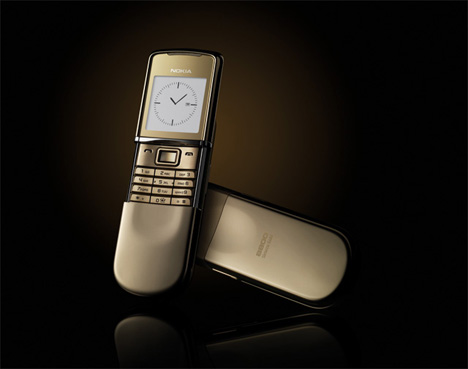
Posted On Friday, June 29, 2007 at at Friday, June 29, 2007 by UnknownInspired by nature, and one of its most beautiful elements, gold, Nokia today unveiled the Nokia 8800 Sirocco Gold - a bold and prestigious new style statement. Encased in a luxurious 18-carat gold plating, the precisely crafted Nokia 8800 Sirocco Gold combines timeless design with a contemporary flair, resulting in an exclusive display of personal style and elegance. The Nokia 8800 Sirocco Gold is now available in select markets, with an estimated retail price of EUR 1000, before taxes or subsidies.
A smooth sliding mechanism reveals a high-resolution camera (2 Megapixel) and the intuitive and ergonomic keypad. Further “inner beauty” highlights of the Nokia 8800 Sirocco Gold include a stunning color screen (up to 262K colors), and a wide array of messaging functionalities. The elegance of the Nokia 8800 Sirocco Gold is also complemented by a coordinating desk stand and color-matching Bluetooth headset.
Design: Nokia
From Recycled Plastic Skin to a Car
Posted On at at Friday, June 29, 2007 by UnknownAny concept vehicle with a name derived from the word the Inuit’s use for their dwellings made of Earth, whalebone, and animal skins is bound to be interesting. Hyundai Europe’s Design and Technical Center in Russelsheim, Germany partnered with GE Plastics in the Netherlands to create the QarmaQ a quirky looking Crossover Coup concept.
One of the QarmaQ’s key features is its innovative use of recycled polyethylene terephthalate (PET) plastic bottles to create a large portion of the vehicle’s skin. GE says the use of plastics, instead of more traditional metal and glass, gives the vehicle a 130-pound weight savings. That weight loss equates to 20 gallons a year savings in gas, not to mention fewer plastic bottles clogging up the local landfill. These numbers are nothing to scoff when you think of all the cars on the road.
The Green theme extends further as the vehicle use less paint and other chemicals that create massive amounts of greenhouse gases. Hyundai said some of the production techniques used in the QarmaQ could roll out beginning with the 2008 model year.
Design: Hyundai [ Via: Treehugger ]



The Credit Card Of The Future
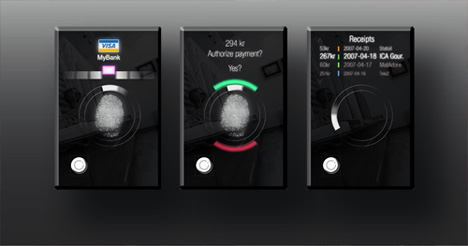
Posted On at at Friday, June 29, 2007 by UnknownI prefer using my bank card over physical cash and here’s why. With a card, I can’t view real-time data on my account usage. In a way I feel I can keep shopping all willy nilly without a care in the world and not feel guilty since I can’t see what it’s doing to my checking account - no doubt bleeding from my frivolous shopping trips.
Designer Jacob Palmborg’s solve for shopaholics like me is an RFID card linked to every account you have. A small interface indicates your own economic situation and forecasts what effects your purchases might have on your future economic status. The whole thing works wirelessly so no actual date is stored on the card. The card also has biometric security so only you can access it. This opens up the possibility of it being your driver’s license, student ID, passport, etc. Now if it only had customizable wallpapers, I’m sold!
Designer: Jacob Palmborg


Top 10 Linux Tools.
Posted On Sunday, June 17, 2007 at at Sunday, June 17, 2007 by Unknown1. nmap - Nmap ("Network Mapper") is a free open source utility for network exploration or security auditing. It was designed to rapidly scan large networks, although it works fine against single hosts. Nmap uses raw IP packets in novel ways to determine what hosts are available on the network, what services (application name and version) those hosts are offering, what operating systems (and OS versions) they are running, what type of packet filters/firewalls are in use, and dozens of other characteristics. Nmap runs on most types of computers and both console and graphical versions are available. 2. Nikto - Nikto is an Open Source (GPL) web server scanner which performs comprehensive tests against web servers for multiple items, including over 3200 potentially dangerous files/CGIs, versions on over 625 servers, and version specific problems on over 230 servers. Scan items and plugins are frequently updated and can be automatically updated (if desired).
3. THC-Amap - Amap is a next-generation tool for assistingnetwork penetration testing. It performs fast and reliable application protocol detection, independant on the TCP/UDP port they are being bound to.
4. Ethereal - Ethereal is used by network professionals around the world for troubleshooting, analysis, software and protocol development, and education. It has all of the standard features you would expect in a protocol analyzer, and several features not seen in any other product.
5. THC-Hydra - Number one of the biggest security holes are passwords, as every password security study shows. Hydra is a parallized login cracker which supports numerous protocols to attack. New modules are easy to add, beside that, it is flexible and very fast.
6. Metasploit Framework - The Metasploit Framework is an advanced open-source platform for developing, testing, and using exploit code. This project initially started off as a portable network game and has evolved into a powerful tool for penetration testing, exploit development, and vulnerability research.
7. John the Ripper - John the Ripper is a fast password cracker, currently available for many flavors of Unix (11 are officially supported, not counting different architectures), DOS, Win32, BeOS, and OpenVMS. Its primary purpose is to detect weak Unix passwords. Besides several crypt(3) password hash types most commonly found on various Unix flavors, supported out of the box are Kerberos AFS and Windows NT/2000/XP/2003 LM hashes, plus several more with contributed patches.
8. Nessus - Nessus is the world's most popular vulnerability scanner used in over 75,000 organisations world-wide. Many of the world's largest organisations are realising significant cost savings by using Nessus to audit business-critical enterprise devices and applications.
9. IRPAS - Internetwork Routing Protocol Attack Suite - Routing protocols are by definition protocols, which are used by routers to communicate with each other about ways to deliver routed protocols, such as IP. While many improvements have been done to the host security since the early days of the Internet, the core of this network still uses unauthenticated services for critical communication.
10. Rainbowcrack - RainbowCrack is a general propose implementation of Philippe Oechslin's faster time-memory trade-off technique. In short, the RainbowCrack tool is a hash cracker. A traditional brute force cracker try all possible plaintexts one by one in cracking time. It is time consuming to break complex password in this way. The idea of time-memory trade-off is to do all cracking time computation in advance and store the result in files so called "rainbow table".
Bill Gates recommends Ubuntu
Posted On Saturday, June 02, 2007 at at Saturday, June 02, 2007 by Unknown
From the telegraph to the digital divide in Uganda, Kenya and Tanzania.
Posted On Thursday, May 31, 2007 at at Thursday, May 31, 2007 by UnknownBefore the digial divide there was hope. This thesis is a prefix to the broadband era and shows how a whole region moved through systems of communication from foot to fidonet email. Interviews with email pioneers, details of 100 years of telecommunications traffic and stories from the turning points of electronic eras build the account of East Africa's hope, rebellion, triumph and submersion.
An investigation into the long term effects of telecommunications in development and the more recent impacts of electronic mail and Internet in Kenya, Tanzania and Uganda. It deals with the detail and contexts of global interconnection from the telegraph to broadband.
SOURCE : http://www.scribd.com/doc/21449/-From-the-telegraph-to-the-digital-divide-in-Uganda-Kenya-and-Tanzania
spray-on contraceptive to be available in North America in the future
Posted On Tuesday, December 05, 2006 at at Tuesday, December 05, 2006 by Unknown
While I agree with sex educator Cory Silverberg's prediction that spray-on contraceptive membranes for men and women probably won't become available in North America for quite some time, if ever, I would love to get all sci-fi with the concept. Flavors, colors, textures, zebra print -- you could do all kinds of things with less reduction of sensation than today's condoms provide.
Every so often I wonder why we haven't yet figured out how to make condoms effective yet indetectable.
Behind the Scene - Darwin's Nightmare - Part 10
Posted On at at Tuesday, December 05, 2006 by Unknown| Mwanza Citizen talking about Darwin's Nightmare. The Making of Darwin's Nightmare. | |
East Africa : Kenya gifts six key oil blocks to China
Posted On Sunday, October 08, 2006 at at Sunday, October 08, 2006 by UnknownThe Chinese have lately taken a keener interest in oil exploration in sub Saharan Africa – regarded as one of the fastest growing oil arenas in the world. A STAFF WRITER reports
Two major European oil exploration companies have protested that they are unable to access Kenya even as the country emerges as the latest frontier in the ferocious global battle between Europe and China for oil resources.


